A few days days ago, someone sent me a screenshot on WhatsApp. It was a bank alert of ₦447,000. The sender is a 23-year-old past student of mine who five months ago was asking me for tips on how to start a successful online business.
He doesn’t have a website yet. No fancy logo. His entire business runs through Instagram Stories, WhatsApp Business, and Selar. He sells an eBook guide on how to write strong CVs for international jobs, plus ready-to-use CV templates.
Meanwhile, another person I know have already spent ₦200,000 on branding, built a beautiful website, registered a company, and hasn’t made a single sale in four months.
Same opportunity. Same market. Completely different outcomes.
Nigeria’s digital economy is racing toward $18.3 billion in 2026. Internet users hit 107 million in early 2025. Payment platforms like Paystack and Selar make collecting money easier than ever. Yet most beginners still fail within their first 90 days.
The reason isn’t what you think.
It’s not capital. It’s not connections. It’s not even competition.
It’s sequence.
Most people start by picking a platform (Facebook, Instagram, TikTok, etc). Then they worry about what to post. Then they panic about sales. This is backwards, and it kills momentum before the first customer arrives.
Successful online businesses in Nigeria follow a different pattern: they validate demand first, build infrastructure second, and scale only what’s already working. Platform comes last, not first.
The system-first vs platform-first mindset
Platform-first thinking says: “I’ll start an Instagram page, post daily, and hope people buy.”
System-first thinking asks: “Who has a problem I can solve? Will they pay to solve it? How do I reach them efficiently?”
One focuses on looking busy. The other focuses on making money.
Here’s the uncomfortable truth: you can have 10,000 Instagram followers and make ₦0. You can also have zero social media presence and make ₦300,000 monthly selling digital products through WhatsApp and Selar. I’ve seen both scenarios play out dozens of times.
The businesses that survive don’t have the best graphics or the most followers. They have systems that consistently convert interest into revenue. Everything else is decoration.
What this guide will help you do differently
This isn’t another article promising passive income or overnight success. This is the exact 6-step system working for regular Nigerians right now:
- Choose the right business model for your actual situation (not the trendy one)
- Validate demand before building anything
- Set up simple infrastructure without overbuilding
- Get your first 5 customers without ads
- Price correctly from day one
- Scale only what already works
No long stories. Just the specific actions that generate revenue in the Nigerian market as of today.
Who this guide is for (and who it’s not)
This guide is for you if:
- You have ₦15,000 to ₦100,000 to invest over 3 – 6 months
- You can commit 10 – 20 hours weekly consistently
- You’re willing to sell to real people, not just post on social media
- You want to build something that makes money, not just looks good online
- You’re comfortable with uncertainty and learning as you go
This guide is NOT for you if:
- You need money this month for urgent expenses (get a job or freelance gig instead)
- You’re chasing quick money or get-rich-quick schemes
- You won’t take action unless you have “perfect” knowledge first
- You can’t handle customers saying no or products not selling initially
- You’re looking for passive income that requires zero effort
Let’s be direct: building a profitable online business in Nigeria takes 3 – 6 months minimum to see consistent income, and 12 – 18 months to replace a salary. If you’re not ready for that timeline, stop reading now and revisit this when you are.
Still here? Good. Let’s build something real.
Step 1: Choose the Right Online Business Model for Your Situation
The business model you choose determines everything: how fast you make money, how much time you’ll invest, and whether you’ll actually enjoy the work.
Most beginners pick based on what’s trending on TikTok or what some influencer is promoting. This is why they quit. The right model matches your current resources, not someone else’s highlight reel.
The 4 Online Business Models That Work in Nigeria in 2026
Model 1: Digital Services (Fastest to Cash)
You sell your time and expertise. Social media management, Graphic design, Virtual assistance, Video editing, Consulting.
Why it works: businesses always need help, and you can start literally tomorrow with skills you already have. No inventory. No product development. Just you, your skill, and clients who’ll pay.
A real example is my friend Chidinma who manages Instagram accounts for three Lagos restaurants. She charges ₦50,000 monthly per client. Total monthly income: ₦150,000. Her startup cost is ₦0. All she did to get these clients was to pitch them directly through Instagram DMs.
Time to first money: 1- 4 weeks
Startup cost: ₦0 – ₦30,000
Profit potential: ₦50,000 – ₦3 million monthly
Effort level: High (you trade time for money)
The trap: You can’t scale past your available hours. At some point, you hit a ceiling unless you raise rates or hire help. But as a beginner? This gets you cash fastest so you can move to other businesses.
Model 2: Digital Products (Highest Margins)
You create once, sell infinitely.
I’m talking about Ebooks, Online courses, Templates, Workbooks, Presets, Audio content, etc
Why it works: Nigeria’s creator economy is exploding. In 2024 alone, Selar paid out ₦9.8 billion to 241,000 creators selling digital products. These aren’t celebrities – these are regular people like you and me packaging what they know and selling it online.
Platforms like Selar (founded in 2016 specifically for African creators) make this absurdly simple. You upload your product, set your price, and start selling in under 5 minutes. Selar handles payment collection in multiple currencies, delivers your product automatically, and pays you. Zero technical setup required.
This model is actually my favourite recommendation if you can pull it off.
Time to first money: 2 – 8 weeks
Startup cost: ₦0 – ₦50,000 (recording equipment if needed)
Profit potential: ₦100,000 – ₦5 million+ monthly
Effort level: High upfront, low ongoing
The trap: Creating products nobody wants. You need to validate demand first (we’ll cover this in Step 2). Also, competition is growing – you need a specific angle or niche to stand out.
Model 3: Content + Monetization (Long-term Wealth)
You build an audience through valuable content, then monetize through multiple streams: affiliate commissions, sponsored posts, digital products, services.
Why it works: once you have attention, you can monetize it repeatedly. A food blogger makes money from recipe ebooks on Selar, sponsored posts from brands, and affiliate commissions from kitchen equipment. Same audience, three income streams.
Selar’s affiliate program alone lets you earn commissions promoting other creators’ digital products.
Time to first money: 3 – 6 months
Startup cost: ₦0 – ₦40,000
Profit potential: ₦150,000 – ₦5 million+ monthly
Effort level: Very high consistency required
The trap: Takes months to build audience. You need to show up consistently for 6+ months before meaningful money appears. Most people quit within 3 months.
Model 4: E-commerce (High Effort, High Risk)
You sell physical products. This could be dropshipping, reselling, or holding your own inventory.
Why it works: Nigerians love shopping online. The e-commerce market is expected to hit $16.68 billion by 2030. But this model has the most moving parts: sourcing, inventory, delivery, returns, customer service.
A real example is my friend who sells perfumes. She sources products from wholesalers and sells through Instagram. She uses Paystack for payments and coordinates delivery through logistics companies. Her monthly profit after costs is around ₦250,000
Time to first money: 1-4 weeks
Startup cost: ₦50,000 – ₦300,000
Profit potential: ₦100,000 – ₦5 million+ monthly
Effort level: Very high (operations-intensive)
The trap: Inventory risk and logistics headaches. Products don’t sell? You’re stuck with them. Delivery delays? Customer complaints. This model makes money but demands constant attention.
How to Choose the Best Model for You
Forget what’s popular. Ask yourself three questions:
Question 1: How much time do you have?
- 5 – 10 hours/week – Digital products. Sell your own products or that of others (affiliate marketing)
- 10 – 20 hours/week – Digital services or content creation
- 20+ hours/week – E-commerce or full-scale content business
Question 2: How much money can you invest?
- ₦0 – ₦20,000 – Digital services or content creation
- ₦20,000 – ₦100,000 – Digital products or affiliate marketing
- ₦100,000+ – E-commerce
Question 3: What skills do you already have?
- Have expertise people pay for (can design/code, etc) – Digital services or Digital products
- Enjoy creating content – Content + monetization
- Comfortable with logistics – E-commerce
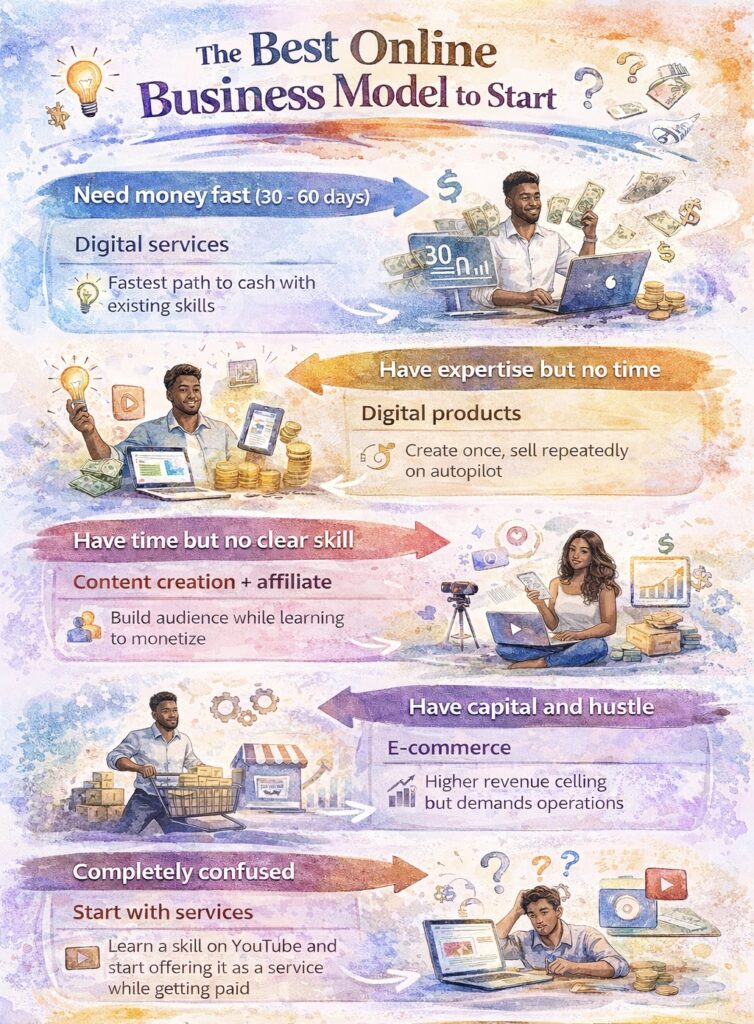
Decision Table for Beginners
| Your Situation | Best Starting Model | Why |
| Need money fast (30 – 60 days) | Digital services | Fastest path to cash with existing skills |
| Have expertise but no time | Digital products | Create once, sell repeatedly on autopilot |
| Have time but no clear skill | Content creation + affiliate | Build audience while learning to monetize |
| Have capital and hustle | E-commerce | Higher revenue ceiling but demands operations |
| Completely confused | Start with services | Learn a skill on YouTube and start offering it as a service while getting paid |
Advice most people ignore:
Don’t try to do everything. I see people talk about about “multiple streams of income” and for this reason, beginners launch a service business, start creating digital products, build a content page, AND try ecommerce simultaneously. They burn out within a few months and quit everything.
Pick ONE model. Give it 90 days of focused effort. Make your first ₦100,000. Then expand if you want. One focused income stream beats three scattered attempts.
Also, the “best” business model is whichever one you’ll actually execute on consistently. A simple service business that runs beats a sophisticated digital product empire that never launches.
Step 2: Validate Demand Before You Build Anything
This is the step most beginners skip. It’s also why they fail.
You don’t need a perfect product. You don’t need a beautiful website. You don’t need a content calendar. You need one thing: proof that people will pay you money.
Everything else is procrastination dressed up as preparation.
What Validation Actually Means (and what it doesn’t)
Validation is NOT:
- Your friends saying “that’s a great idea!”
- Random people liking your Instagram post
- 50 comments saying “I’d definitely buy this”
- A poll where people vote yes
These cost nothing, so they mean nothing.
Validation Is:
- Money changing hands
- Someone paying before the product is perfect
- Actual purchase decisions, not interest signals
Here’s the brutal truth: people lie, not maliciously – they just overestimate their future behavior. Your WhatsApp contacts who said “I’d totally buy that course for ₦15,000” won’t actually buy when you launch. But if someone transfers ₦15,000 now to pre-order? That’s real.
Why likes and comments don’t count
Likes are free. Purchases require decision, sacrifice, and trust. The gap between “I like this” and “I’ll pay for this” is massive.
I’ve seen Instagram posts get 300 likes and generate zero sales. I’ve also seen WhatsApp messages to 20 people generate 8 purchases. Engagement metrics feel good but don’t pay rent.
The only validation that matters is payment
If you can get 5 -10 people to pay you before your product is perfect, you’ve validated demand. If you can’t, you haven’t – regardless of how many people said they’re interested.
This one insight will save you months of wasted effort.
Three Simple Validation Methods That Work in Nigeria
Method 1: The WhatsApp Pre-Sell
This is the fastest validation method that exists.
Here’s how it works:
- Write a simple offer (what you’re selling, who it’s for, what problem it solves, price)
- Send it to 50 -100 contacts on WhatsApp or just drop it on your WhatsApp status
- Count how many people transfer money
- If 3+ people pay, you’ve validated demand
- If zero people pay, your offer needs work or there’s no demand
Method 2: The Instagram Test
Similar concept, different platform.
- Create a simple post or story describing your offer
- Add “DM to buy”
- Count responses and see who makes a payment
- 10+ people asking about it is warm signal
- 3+ people paying is validation
Don’t make the mistake of waiting for massive engagement. You don’t need 500 comments. You need 3 – 5 people willing to transfer money.
Method 3: The Google Search Demand Test
Before creating anything, check if people are actively searching for it.
Use Google Trends (trends.google.com), set location to Nigeria, and search keywords related to your product.
Example: “How to start online business Nigeria”
High search volume = good demand, and Very low search volume equals zero demand.
If Nigerians are searching for it monthly, there’s likely demand. If search volume is zero, you’re creating something nobody’s looking for.
You can also check Selar’s marketplace to see which digital products are selling in your category. If similar products exist and have sales, demand exists.
How to Know When an Idea is Worth Pursuing
When to pivot vs persist:
Pivot if: After reaching 100+ people, zero sales materialize. The market is telling you something.
Persist if: You get 1-2 sales from 50 people. That’s 2-4% conversion – adjust your messaging and keep going.
One sale proves demand exists. Zero sales from 100+ people proves it doesn’t.
Step 3: Set Up Simple Business Infrastructure
You’ve validated demand. Now you need basic infrastructure to collect money and deliver value.
Notice the sequence? validation first, infrastructure second. Most beginners reverse this and waste money building things nobody uses.
What You Need to Start (and what you don’t)
What you NEED:
1. Payment collection You need a way for customers to give you money. That’s it.
Options:
- Selar (best for digital products)
- Paystack (best for services/general)
- Direct bank transfers
For digital products, Selar is the obvious choice. Create account, upload product, set price, share link. Someone buys, Selar handles payment collection and automatic delivery. You get paid.
For services or physical products, Paystack works perfectly. Simple payment links, no website required.
2. Delivery system: How does the customer get what they paid for?
For digital products: Selar delivers automatically
For services: WhatsApp or email
For physical products: Delivery companies
3. Online presence: Where do customers find you and learn about your offer?
Since you’re just getting started, you shouldn’t pay so much attention to paid ads at this stage except you have the budget. Simply use the following:
- WhatsApp Business account (free)
- Instagram, Facebook, or X (Twitter) pages (free)
- Simple link-in-bio (Bio.fm, Linktr.ee – all free)
That’s literally it. WhatsApp + Social media page + Payment link = fully functional online business. For simple designs, you can use the free version of Canva to come up with marketing materials such as flyers or banners.
What you DON’T need:
- Custom website (not yet)
- Paid email marketing tool (not until 100+ customers)
- Fancy branding and logo (Instagram posts sell products, not logos)
- CAC registration (not until you’re consistently making ₦150,000+/month)
- Physical office (you have internet, use it)
- Multiple social media platforms (pick one, master it first)
Beginners make the mistake of spending up to ₦200,000 on infrastructure before making any sales. Don’t do that. Build what you need when you need it, not before.
Step 4: Get Your First 10 Customers Without Ads
Paid advertising comes later. First, you need to prove you can make sales manually.
Why? Because ads amplify what already works. If you can’t sell to people you know, you won’t magically sell to strangers on Facebook. Fix the fundamentals first.
Why Organic Sales Matter First
Feedback
Your first 10 customers teach you everything. What messaging resonates. What objections people have. What features they actually care about. What price feels right.
This is the information that you can then use to create your messaging for paid ads.
Skill Development
Selling manually builds muscles you’ll need forever: understanding customer psychology, handling objections, closing deals, delivering value, asking for referrals.
If you skip straight to ads, you outsource these skills to Facebook. Then when ads stop working (they always eventually do), you’re helpless.
Proof Before Scale
Having 10 organic sales prove three things:
- Your offer works
- People will pay your price
- You can deliver the promised value
Now you’re ready to scale with ads, confident the fundamentals work. Scaling before proof is gambling with your money.
Three Customer Acquisition Channels That Work for Beginners
1. WhatsApp
This is the most underrated sales channel in Nigeria.
WhatsApp isn’t just for broadcasting messages. It’s a complete customer acquisition and sales system when used strategically. Here are three WhatsApp strategies that actually convert:
Strategy 1: Status Marketing
Your WhatsApp Status reaches everyone who has your number. Unlike broadcast lists, there’s no 256-contact limit.
How to use it:
- Post valuable tips on Status daily (business advice, quick wins, industry insights)
- Every 3 – 4 Status posts, include a soft pitch about your offer with a call-to-action
- Use the link feature to direct people to your Selar product or payment link
- Track who views your Status consistently – these are warm leads, they have the potential to buy from you.
Strategy 2: One-on-One Relationship Selling
WhatsApp’s real power is personal connection. Unlike Instagram DMs that feel formal, WhatsApp feels intimate.
The framework:
- Start with value-first conversations (not pitches)
- Ask questions about their challenges
- Share relevant free resources or advice
- When trust is built (usually 3-5 conversations), naturally mention your offer
- Send payment link only after they express genuine interest
Strategy 3: WhatsApp Community/Group Strategy
Create a free WhatsApp group offering value in your niche. Position yourself as the expert.
How it works:
- Create a WhatsApp group (max 1,024 members)
- Invite people interested in your topic (promote on social media – Facebook, Instagram, X (Twitter), etc)
- Share valuable content 3 – 4 times weekly (tips, resources, Q&A sessions)
- Build authority and trust over time
- Once a week, subtly mention your paid products/services
- Interested members DM you privately to buy
Bonus: WhatsApp Broadcast (The Classic)
Don’t ignore broadcasts entirely – they still work when used strategically.
Quick broadcast framework:
- Build list by offering free valuable resource
- People message you, save their numbers
- Create broadcast list in WhatsApp Business (up to 256 contacts per list)
- Send valuable content 1 to 2 times weekly
The key: broadcasts work best for existing customers and highly engaged contacts, not new contacts or strangers. Please don’t send unnecessary broadcasts especially to people not familiar with you. You’ll annoy them and eventually get blocked. Use broadcasts to nurture relationships and make repeat sales, not for initial acquisition.
Channel 2: Instagram Content Marketing
Content marketing works, but most people do it backwards. They post random content hoping something works.
Strategic content follows a pattern:
80% educational/valuable:
- How-to posts in your niche
- Common mistakes and how to avoid them
- Quick wins your audience can implement
- Behind-the-scenes of your process
20% promotional:
- Direct pitch for your product/service
- Customer results and testimonials
- Limited-time offers
- “DM to buy” posts
Post daily. Yes, daily. Consistency beats perfection.
Also engage genuinely. Spend 20 minutes daily commenting on posts in your niche, answering DMs, replying to comments. Relationships sell, not just content.
Channel 3: Cold Outreach
Most people hate cold outreach because they do it terribly. “Hi, I’m selling X, are you interested?” That’s spam!
Professional cold outreach looks different:
On LinkedIn:
- Find your ideal customer (use search filters)
- Send connection request (no pitch)
- Once connected, send a value-first message: “Hi [Name], noticed you run [Company]. I recently helped [Similar Company] solve [Specific Problem] and thought you might find this case study useful. Would you like me to send it?”
- If they respond positively, start conversation
On Instagram DM:
- Engage with their content first (2-3 genuine comments over a week)
- DM complimenting specific content, asking a question
- Build brief relationship
- Mention what you do naturally in context
- If relevant, offer solution
Message 50 people, 10-15 respond, 2-3 become customers. That’s normal.
What to Say When Selling (So You Don’t Sound Pushy)
The reason most people feel pushy when selling: they talk about themselves instead of the customer’s problem.
Bad sales message: “Hi! I’m a graphics designer with 5 years of experience. I create amazing logos and brand identities using Adobe Illustrator and Photoshop. My rates are very affordable. Interested?”
Nobody cares about you. They care about their problem.
Good sales message: “Hi [Name], noticed your Instagram page doesn’t have consistent branding – the colors and fonts change in every post. This makes your brand look less professional than it actually is, and potential customers notice. I help small businesses create simple brand guidelines (colors, fonts, templates) so everything you post looks professional and cohesive. Would a 10-minute call to discuss this be helpful?”
See the difference? One talks about the seller. One talks about the buyer’s specific, observable problem and offers a clear solution.
Problem-first messaging framework:
- Identify their specific problem (not generic, specific and observable)
- Explain why this problem matters (the cost of not solving it)
- Present your solution (how you specifically solve this problem)
- Provide easy next step (“Book a call,” “Reply YES,” “Check out examples”)
Simple offer structure:
Your offer needs three elements:
- What they get – “30-page ebook on profitable online business models in Nigeria”
- What problem it solves – “So you stop wasting time on business ideas that don’t work in our market”
- Price and access – “₦5,000. Instant delivery on Selar.”
That’s it. Don’t overcomplicate.
Follow-up rules:
Rule 1: Always follow up. Most sales happen on the 3rd-7th touchpoint, not the first.
Rule 2: Provide value in follow-ups, don’t just ask “have you decided?”
Good follow-up: “Hey! Saw this article on [topic relevant to their problem]. Thought of you. Also, reminder that my offer on [solution] is still available if you’re interested.”
Rule 3: Know when to stop. After 3 – 4 follow-ups with no response, move on.
Step 5: Price Your Offer for Survival and Growth
Pricing terrifies beginners. Too high and nobody buys. Too low and you can’t survive.
Here’s the truth: there’s no “perfect” price. But there are some example price ranges that work based on your model and the Nigerian market.
How to Set Beginner Pricing (With Examples)
Note that these prices are just estimates to give you an insight on what it looks like. You can choose to price higher than these examples as long as you deliver value
Service Pricing Ranges:
Entry-level freelance services:
- Social media management: ₦50,000 – ₦100,000/month per client
- Graphic design: ₦10,000 – ₦25,000 per deliverable (logo, flyer, social graphics)
- Virtual assistant: ₦50,000 – ₦100,000/month
- Video editing: ₦10,000 – ₦35,000 per video
Mid-level services (with portfolio):
- Brand identity design: ₦80,000 – ₦200,000
- Website design: ₦100,000- ₦1,000,000
- Consulting: ₦80,000 – ₦250,000/month retainer
Your first few clients: charge toward the lower end. As you build portfolio and testimonials, increase your prices.
Product Pricing Ranges:
Digital products on Selar:
- Short ebooks (20 – 40 pages): ₦2,500 – ₦7,000
- Comprehensive guides (60+ pages): ₦8,000 – ₦20,000
- Templates/Resources: ₦3,000 – ₦10,000
- Mini courses (1-3 hours video): ₦8,000 – ₦25,000
- Full courses (5+ hours): ₦15,000 – ₦80,000
- Membership/subscription: ₦5,000 – ₦15,000/month
Physical products (margins matter more than price):
- Aim for 40 – 100% profit margin minimum
- If something costs ₦5,000 to source, sell for ₦8,500 and above
Coaching Pricing Ranges:
One-on-one:
- Single session: ₦15,000 – ₦50,000
- Monthly package (4 sessions): ₦50,000 – ₦150,000
- 3-month program: ₦120,000 – ₦400,000
Group programs:
- Workshop (single session): ₦5,000 – ₦15,000 per person
- Multi-week cohort: ₦25,000 – ₦80,000 per person
Pricing Mistakes That Kill Momentum
1. Undervaluing
The most common beginner mistake. You charge ₦2,000 for something worth ₦15,000 because you “don’t want to be expensive.”
If you spend 5 hours creating something and charge ₦2,000, you earned ₦400/hour. A POS operator makes more.
You’re not helping customers by being cheap. You’re destroying your ability to sustain the business.
Price based on value delivered, not time spent. If your ₦15,000 course helps someone start a business that makes ₦200,000, you’re actually cheap at ₦15,000.
2. Copying Foreign Markets
You see a US creator selling similar products for $97. You think “I should charge the same to match quality.”
That’s a terrible idea. Nigerian purchasing power is different. $97 is a small expense in the USA, but a significant expense in Nigeria. $97 is about ₦150,000. Most Nigerians can’t afford to pay that for a course.
Adjust for the local market. That $97 US product should probably be ₦15,000 – ₦35,000 in Nigeria. Still premium, but realistic.
3. Fear-Based Pricing
“What if people think it’s too expensive?”
Some will. That’s fine. You’re not selling to everyone.
If 30 people say no because of price but 5 people say yes, you’ve made sales. The 30 no’s don’t matter. The 5 yes’s do.
Don’t let imaginary objections from people who weren’t going to buy anyway control your pricing.
How to know if your price is right:
Too low signals:
- Customers buy instantly without asking questions
- You’re overwhelmed with work but making little money
- People say “that’s cheap!” or seem surprised by the price
Too high signals:
- Literally nobody buys after 50+ conversations
- Only objection is price, even from ideal customers
- You’re way above competitor prices with no clear differentiation
Just right signals:
- Some people buy, some don’t (roughly 3-10% conversion)
- Occasional price objections but many people find it reasonable
- You can sustain yourself at current sales volume
Expect roughly 5-10% of people to buy at correct pricing. If 1 in 10 people buy, your price works.
Step 6: Scale Only What Already Works
Most beginners try to scale too early. Or they scale everything at once. Both mistakes like that kill businesses.
You don’t scale until you have proof of concept. And when you scale, you scale one thing at a time.
When Should Scale
Watch out for the following signals before you scale.
Signal 1: Consistent Sales
You’ve made sales 3 months in a row. Not one random month of ₦100,000 followed by two months of ₦0. Actual consistency in sales!
Signal 2: Clear Demand
You’re turning people away. Your calendar is full. Your products sell out. You can’t serve everyone who wants to work with you.
This is the best problem to have. It means you’re ready to add capacity.
Signal 3: Repeatable Process
You know exactly how you get customers. It’s not random luck. You can explain your process and repeat it.
Example: “I post 5 educational Instagram posts weekly, convert engaged followers to WhatsApp broadcast list, send valuable content 3x/week with one pitch, convert 5-7% to Selar purchases.”
If you can’t document your process, you’re not ready to scale.
Four Safe Ways to Scale an Online Business in Nigeria
Method 1: Ads to Winning Offer
Now you already understand your process, you have a winning strategy and you’ve making consistent sales. This is the time to start paid ads.
You know your offer converts organically. You know your messaging works. You know your pricing is correct. Ads just put your proven offer in front of more people.
Start small: ₦10,000 – ₦20,000 test budget on Instagram, Facebook, Snapchat or TikTok ads.
Track everything: cost per click, cost per purchase, return on ad spend.
If ₦20,000 in ads generates ₦60,000 in sales, you’ve got 3X ROAS (Return On Ad Spend). Scale up. If ₦20,000 generates ₦15,000 for maybe two to three days, stop ads and fix your offer first. Here is a video on how to run paid ads on Facebook.
Method 2: Hiring Help
When you’re overwhelmed and turning down revenue opportunities, hire many hands:
Start small:
- Part-time VA for ₦30,000 – ₦50,000/month to handle customer service
- Delivery person for ₦5,000 – ₦10,000/week for logistics
- Content creator for ₦40,000 – ₦60,000/month for social media
Only hire when the role generates more revenue than it costs. Don’t hire because you “should have a team.”
Method 3: Productizing Services
You sell social media management for ₦60,000/month. You work with 5 clients, earn ₦300,000, but you’re maxed out on time.
Options to scale:
- Create “Social Media Manager Toolkit” (templates, systems, checklists) and sell on Selar for ₦12,000 to other aspiring managers
- Record yourself doing the work, turn it into a course
- Package your processes as a DIY product for business owners who can’t afford your service
Method 4: Email List Leverage
There is money in email marketing, and you can get started with the free tools. An email marketing tool like Kit (formerly Convertkit) allow you use the platform for free untill after you’ve gotten over 10,000 email subscribers.
Build an email list of your customers from day 1 (Kit is free). Offer a free resource, collect emails, send valuable content weekly. When you launch new products, you have a warm audience ready to buy.
Scaling Mistakes That Destroy Profits
Mistake 1: Scaling Too Early
You made ₦50,000 last month and immediately want to hire staff, rent an office, and run ₦1,000,000 in ads.
Please slow down. One month of sales doesn’t prove sustainability. Scale only after 3+ months of consistent revenue.
Premature scaling is the #1 killer of profitable small businesses.
Mistake 2: Adding Complexity
Your simple Instagram + Selar setup is working. You’re making ₦200,000 monthly. Then you decide to:
- Add TikTok
- Start a YouTube channel
- Build an app
- Launch a podcast
- Create 5 new products
Complexity breaks focus. You go from ₦200,000/month doing one thing well to ₦80,000/month doing five things poorly.
Mistake 3: Ignoring Your Numbers
When you run ads, you should track your profit per customer.
Example: You spend ₦50,000 on ads, generate 30 sales at ₦5,000 each (₦150,000 revenue).
Looks profitable, right?
But your product costs ₦2,000 to fulfill. So actual profit per sale is ₦3,000. Times 30 sales = ₦90,000. Minus ₦50,000 ad spend = ₦40,000 net profit.
Now you scale to ₦200,000 in ads thinking you’ll make more money.
You generate 120 sales. Revenue is ₦600,000, fulfillment costs ₦240,000, Ad costs ₦200,000 and Net profit is ₦160,000.
Seems good until you realize you invested ₦440,000 (fulfillment + ads) to net ₦160,000. Your margin dropped to 36%. One bad month and you’re in trouble.
Know your numbers:
- Profit per sale (after ALL costs)
- Customer acquisition cost
- How many sales you need to break even
- True profit margin
Scale only when unit economics make sense.
Common Beginner Mistakes That Kill Online Businesses in Nigeria
There are many mistake that might hinder the growth of your online business, but I’m only going to focus on the common ones. I’ve been a victim of these mistakes so I understand the level of damage they do to beginners trying to succeed online.
Below are the silent killers:
Shiny Object Syndrome
This is the most common among all. You start selling digital products. Two weeks in, you see someone making money with dropshipping and you pivot immediately. One month later, you discover affiliate marketing. You pivot again.
Six months later, you’ve started and quit five businesses. None got past week three and you never recorded success with any of them, you just wasted your time.
This is where discipline comes into play. Commit to one model for at least 90 days minimum. That’s enough time to learn, adjust, and see if it works for you. I wouldn’t recommend anything less than that.
Platform Hopping
Let’s say you start on Instagram. You try for two weeks and it doesn’t seem to be working, so you switch to TikTok. TikTok isn’t working after a month, so you try Twitter. Three months later, you’re on five platforms with zero traction on any.
The truth is that platforms don’t make you money. Your ability to consistently provide value and sell makes you money. That skill transfers across platforms.
Pick one platform. Master it for 6 months. Then expand if needed.
Learning Without Executing
You’ve probably watched up to 30 YouTube videos on starting an online business, you’ve taken multiple courses, you’ve even read 12 ebooks. In theory, you know everything about starting an online business. You are a guru, yet you haven’t made a single sale online.
You haven’t launched a product, you haven’t sold any of your skills, you haven’t sold an affiliate product at least.
Knowledge without execution is entertainment, not progress.
Now set a new rule: for every hour of learning, spend three hours executing. Otherwise you’re a professional student, not a business owner.
Overplanning, Under-selling
I know someone who spent four months perfecting their online course. Professional editing, beautiful slides and all that cool stuff.
When he eventually launched, he made Zero sales in the first month.
Meanwhile, someone else recorded a quick video on their phone, launched quickly, and made over ₦300,000 in three weeks.
So here is the difference…
One was trying to launch perfectly while the other was trying to help people solve a problem.
Your customers don’t need your perfect version. They need your working version. They need the solution you’re sitting on while you endlessly polish and plan. You don’t need to have it all figured out, you can even start with your smartphone if you don’t have a computer.
Done and selling beats perfect and planned. Money loves speed so try to always execute quickly!
Launch whatever you have then learn from your customers and improve on your products and services based on the feedback you get from your buyers.
Conclusion
Nigeria’s online business opportunity is real. In fact Nigeria has the highest population in the whole of Africa, and there are lots of opportunities here. You can make crazy figures selling only to Nigerians. You don’t need to chase foreign clients to succeed online. The infrastructure exists here (Selar, Paystack, Social Media). The customers are here (About 107 million internet users and growing). The barriers are lower than they’ve ever been and you even have AI to assist you with most of the hard work!
But opportunity doesn’t equal results. Execution does.
The framework in this guide works. I’ve watched it work for different people across various industries.
But here’s the uncomfortable truth: most people reading this won’t execute. They will feel motivated for 48 hours, then return to exactly what they were doing before.
Don’t be that person.
You don’t need more information. You need to validate one idea and make one sale. Start today, not next week.
People will keep making money online, with or without you. The question is simple:
Will you get a piece of this cake or just watch others eat?
The choice is yours my friend.