Every week, I watch the same pattern repeat itself. Someone starts an online business, maybe a dropshipping store because they saw it trending on social media. Three weeks later, they quit and try affiliate marketing. A month after that, they’re convinced content creation is the answer. Six months pass and they’ve started four businesses but built none of them.
The problem isn’t lack of ideas or opportunity. The problem is choosing businesses that don’t match who they actually are, what skills they have, or how they prefer to work. You can have the best online business model in the world, but if it requires skills you hate using or patience you don’t have, you’ll quit before seeing results.
Choosing the right online business saves you time, money, and the frustration of constantly restarting. In this guide, I will show you a simple way to choose an online business based on your actual skills, your personality, and your current situation, not based on what’s trending or what someone else is doing successfully.
The business that works isn’t always the most popular one. It’s the one you can sustain long enough to see results.
Why Choosing the Wrong Online Business Causes Most People to Fail
Most beginners fail not because they picked a bad business model, but because they picked the wrong business model for them specifically.
Here’s what happens: someone sees a YouTube video about someone making $500 monthly from content creation. They start a YouTube channel despite hating being on camera and never finishing videos they start recording. Two months in, they’ve uploaded three videos, gotten 47 total views, and they’re exhausted. They quit, convinced online business doesn’t work.
The problem wasn’t that content creation is bad. The problem was that content creation required skills and personality traits they didn’t have and weren’t willing to develop.
Common mismatches that kill momentum:
People choose businesses because they’re trending, not because they fit their skills. Dropshipping was hot in 2022, so thousands started stores despite knowing nothing about product sourcing, customer service, or logistics. Most quit within 90 days.
People choose businesses that require skills they actively dislike using. If you hate writing, starting a blog-based business will feel like punishment. You’ll avoid the work, post inconsistently, and eventually stop.
People choose businesses that require more patience than they have. Content creation takes 6-12 months to generate meaningful income. If you need money in 60 days, content creation is the wrong choice regardless of how much you enjoy it.
People choose businesses that require capital they don’t have. Importing products sounds exciting until you realize you need ₦200,000 – ₦500,000 to start properly and you only have ₦50,000.
The result is always the same: you quit early, blame the business model, and start searching for the next “easy” opportunity.
The truth that most people don’t want to hear is that the best online business for you is not the most profitable one, not the trendiest one, and not the one your favorite influencer promotes. It’s the one you can actually sustain doing consistently for 6-12 months while you build momentum.
How Do You Choose the Right Online Business?
Step 1: Identify the Skills You Already Have
You don’t need to learn everything from scratch. Most people already have skills that can directly translate into profitable online businesses. They just don’t recognize these skills as valuable because they’ve been using them casually.
Existing professional skills you might overlook:
If you’ve worked in any job for 2+ years, you have transferable skills. Someone who worked in customer service understands communication, problem-solving, and managing client expectations. That’s social media management or virtual assistant work. Someone who created presentations at their office job knows design basics and how to communicate ideas visually. That’s graphic design or presentation design services.
You write clear emails that get responses. That’s copywriting or content writing. You organize events or coordinate teams. That’s project management or online business management. You explain complex topics to colleagues in simple terms. That’s teaching, coaching, or creating educational content.
Informal skills you use daily without thinking:
You spend hours on Instagram and understand what content performs well. That’s social media strategy knowledge. You edit videos on your phone for fun and friends ask you to edit theirs. That’s video editing. You naturally organize information and create systems. That’s operations or workflow consulting. You give good advice and people come to you for guidance. That’s coaching or consulting.
Skills you can learn quickly if needed:
Not having a skill today doesn’t disqualify you permanently. Many online business skills can be learned in 4-12 weeks through free YouTube tutorials, practice, and doing actual client work.
Basic graphic design using Canva: 2-4 weeks. Simple video editing using CapCut or InShot: 3-6 weeks. Social media management fundamentals: 4-8 weeks. Content writing basics: 4-8 weeks. Website building with WordPress or no-code tools: 6-12 weeks.
The key is choosing skills you’re genuinely interested in developing, not just skills that seem profitable.
Simple exercise to identify your skills:
Write down 5 things people regularly ask you for help with. These are your natural skills. Your coworker always asks you to review their presentations before meetings. You have an eye for design. Your friends ask you to explain the latest tech stuff in simple terms. You can teach and simplify complex topics. Your family members ask you to fix their social media profiles and all. You understand platforms and content strategy.
Whatever shows up repeatedly in your life is probably a skill you can monetize online.
Step 2: Decide Whether You Prefer Service, Product, or Content-Based Business
Once you know your skills, you need to choose which business model category fits how you want to work. There are three main types, and each has different characteristics.
Service-based businesses (you trade time for money):
You offer your skills directly to clients who pay you for specific work. Examples include social media management, freelance writing, video editing, graphic design, virtual assistance, and consulting.
Best for people who want fast income. You can make your first $1000 in two months if you actively reach out to potential clients. Best for beginners because you learn while getting paid. Every client teaches you something that makes you better at your skill.
The downside is that your income is limited by your available time. You can only take so many clients before you’re overwhelmed. Scaling requires raising prices or hiring help.
Product-based businesses (you create or source once, sell repeatedly):
You sell digital products (ebooks, courses, templates, designs) or physical products (through dropshipping, reselling, or your own inventory). Examples include selling Canva templates, creating online courses, reselling products on Instagram, or running an e-commerce store.
This is best for people who want scalable income. Once you create a digital product, you can sell it infinitely without additional work per sale. If you prefer working independently rather than managing client relationships and expectations, then this is for you.
The downside however, is that it takes longer to see income. Creating a quality product takes time, and marketing it to find buyers takes even more time. Expect 2-6 months before consistent revenue.
Content-based businesses (you build audience, monetize multiple ways):
Here you create content consistently (videos, blog posts, social media posts) to build an audience, then monetize through ads, sponsorships, affiliate marketing, or selling your own products. Examples include YouTube channels, blogs, Instagram pages, TikTok accounts, and podcasts.
This is good for long-term income and people comfortable sharing ideas publicly. Once you have an audience, you can monetize it in multiple ways simultaneously. Best for people who enjoy creating content and don’t mind that results take time.
The downside is the longest timeline to income. Most content creators take 6-12 months to make their first $200 monthly. Many quit before reaching that point.
Which should you choose?
If you need money within 60 days, choose service-based. If you can wait 3 – 6 months and want to build something scalable, choose product-based. If you’re willing to invest 6 – 12 months and enjoy creating content, choose content-based. You can also combine them: start with services for immediate income, then build products or content on the side.
Step 3: Consider Your Personality (This Matters More Than You Think)
Your personality determines whether you’ll sustain a business long enough to succeed. I’ve seen brilliant people fail at businesses that don’t match how they naturally work.
If you don’t like being on camera or talking to people constantly:
Avoid businesses that require heavy video presence like YouTube, TikTok, or video coaching. Instead, focus on behind-the-scenes work like writing, graphic design, data analysis, video editing for others, or text-based content.
If you prefer working alone without client management:
Service businesses might drain you because they require constant communication, managing expectations, and dealing with revisions. Consider product-based businesses where you create once and sell through automated systems, or content businesses where your audience interaction is optional.
If you enjoy teaching and explaining things:
Coaching, consulting, creating educational content, or course creation fits naturally. You’ll enjoy the work instead of forcing yourself through it, which means you’ll stick with it longer.
If you like technical, detail-oriented tasks:
Video editing, web development, graphic design, or data-related work suits you better than content creation or sales-heavy businesses.
If you thrive on variety and get bored easily:
Service businesses offering different projects to different clients give you variety. Avoid businesses that require doing the same thing repeatedly like managing one large client’s social media for months.
If you need external validation and feedback:
Content creation or coaching gives you regular feedback from audiences or clients. Product businesses where you sell through automated systems might feel isolating.
The business that matches your personality is the business you’ll actually do consistently. Consistency beats skill, strategy, or even opportunity every single time.
Step 4: Consider Your Time and Income Urgency
Your current financial situation should heavily influence which online business you start first.
If you need money within 30 – 60 days:
Service-based businesses are your only realistic option. You can land your first client within 2 – 4 weeks if you actively reach out, offer competitive pricing, and deliver quality work. Examples that generate fast income include social media management, freelance writing, video editing, and virtual assistance.
Start offering your services immediately, even if you don’t feel 100% ready. You’ll learn faster by doing actual client work than by studying for another month.
If you can wait 3 – 6 months:
Product-based businesses become viable. You have time to create quality digital products, set up proper sales systems, and test marketing approaches. Use the first 2 – 3 months to create your product while potentially doing service work on the side for income. Launch the product in month 3 – 4 and refine based on sales and feedback.
If you’re building for 6 – 12 months out:
Content-based businesses make sense. You can invest time building an audience knowing that monetization comes later but has higher long-term potential. The best approach here is combining it with another income source (job, service business, savings) to sustain yourself during the building phase.
The hybrid approach (My Personal Recommendation):
Start with service-based work to generate immediate income. Use 70% of your time on client work, 30% on building a product or content business. After 4 – 6 months, when your product or content starts generating income, shift to 50-50. Eventually phase out services if you want, or keep a few high-paying clients while your other business grows.
This approach gives you the security of consistent income while building long-term assets. Many successful online entrepreneurs followed this path whether they admit it or not.
Step 5: Choose ONE vehicle and Ignore the Rest
Here’s where most people sabotage themselves: they try to start three businesses simultaneously.
They’re building a YouTube channel, trying to land freelance writing clients, and running an ecommerces business all at the same time. Three months later, the YouTube channel has 5 videos, they landed one writing client who they couldn’t serve well because they were distracted, and the ecommerce business never launched.
The biggest mistake beginners make is not committing to one business long enough to see results.
Every business model works for someone. But no business model works if you give it 30 days of scattered attention before jumping to the next opportunity.
Why focus matters more than anything else:
You make faster progress when all your energy goes to one thing. You learn faster, you improve faster, you start making money faster. You get less confused because you’re not splitting mental energy across multiple strategies and platforms. You build momentum, and momentum is what carries you through the difficult middle period when results haven’t shown up yet but you’re past the exciting beginner phase.
The 90-day commitment rule:
Choose one business model. Commit to working on it consistently for at least 90 days before you even consider switching. Ninety days isn’t arbitrary. It’s roughly how long it takes to get past the beginner learning curve, make your first few sales or land your first few clients, and actually understand whether the business model suits you.
Most people quit between days 20 – 45 when the initial excitement fades but results haven’t arrived yet. The ones who push through to day 90 almost always start seeing traction.
Simple Decision Framework
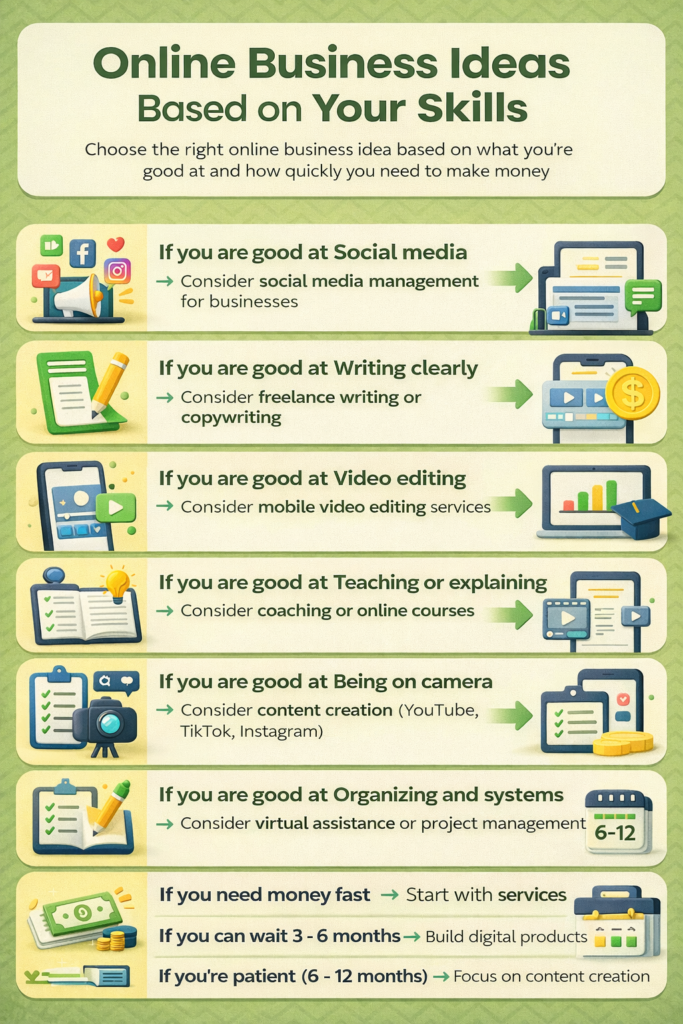
Here is a guide to help you make your decision.
If you are good at Social media – Consider social media management for businesses
If you are good at Writing clearly – Consider freelance writing or copywriting
If you are good at Video editing – Consider mobile video editing services
If you are good at Teaching or explaining – Consider coaching or online courses
If you are good at Being on camera – Consider content creation (YouTube, TikTok, Instagram)
If you are good at Organizing and systems – Consider virtual assistance or project management
If you are good at Design – Consider graphic design or selling design templates
If you need money fast – Start with services
If you can wait 3 – 6 months – Build digital products
If you’re patient (6 – 12 months) – Focus on content creation
Checkout the infographics below:
Common Mistakes to Avoid
Choosing based on hype: Just because everyone is talking about AI writing tools or YouTube Automation doesn’t mean it’s the right business for you. Trends come and go. Skills and personality traits don’t.
Choosing based on what others are doing: Your friend makes $1000 monthly from affiliate marketing. That’s great for them. It doesn’t mean affiliate marketing suits your skills or work style.
Expecting instant success: Every successful online business you see took 6 – 18 months minimum to get there. The most success stories you see online are either outliers or lies. Plan for a realistic timeline.
Quitting too early: You tried content creation for 6 weeks, posted 10 times, got minimal engagement, and decided it doesn’t work. That’s not long enough to know anything. Give it 90 days minimum.
Overthinking instead of starting: You’ve spent three months researching, watching tutorials, and planning. You haven’t made a single offer, created a single piece of content, or reached out to a single potential client. Your tesearch feels productive but it’s not, please start imperfectly and learn as you go.
What to Do After Choosing Your Online Business
Once you’ve chosen your business model, here are your immediate next steps:
Learn just enough to start. Don’t spend six months studying. Watch 3 – 5 tutorials or read 2 – 3 articles on your chosen business, then start doing it. You’ll learn more from one real client or one real product launch than from 100 hours of tutorials.
Set up basic tools. Install the apps you need (Canva for design, CapCut for video editing, WhatsApp Business for client communication). Create accounts on relevant platforms. This takes one day maximum.
Practice with real projects. Create 2 – 3 sample pieces of work even if you don’t have clients yet. Sample social media posts, practice articles, edited video clips, whatever your business requires. You need something to show when people ask you “can I see your work?”
Get your first client or create your first product. Don’t wait for perfection. Reach out to 20 – 30 potential clients if you’re doing services, or create and launch your first product if you’re going that route. Action creates momentum. Planning creates delay.
If you need more specific guidance on launching, you can read detailed step-by-step processes for starting specific online businesses with just your smartphone or building your first digital product. The key is choosing first, then learning the specifics of execution for that specific model.
Conclusion
There is really no perfect online business. There’s only the business that matches your current skills, personality, time availability, and financial situation.
The person making $5,000 monthly from content creation isn’t more talented than you. They just chose a business that matched their strengths and stuck with it long enough to see results. You can do the same thing with a different business model that fits you better.
Stop waiting for the perfect moment, the perfect idea, or the perfect setup. Choose a business that makes sense based on what you just read, commit to 90 days minimum, and start today. Not Monday. Not next month. Today.
The best online business is the one you actually start and sustain long enough to build something real.