Two businesses target the same audience. They spend the same amount. They offer similar services at similar prices. One acquires customers profitably and grows steadily. The other burns through budget, struggles to convert, and concludes that the market is too competitive or the ads aren’t working.
The ads are rarely the problem.
Most discussions about customer acquisition costs focus on the mechanics of media buying. How do we lower the cost per click? How do we improve our targeting? Which platform gives us the cheapest leads? These are legitimate questions and the answers matter. But they address the surface of the problem while leaving the root cause untouched.
The root cause, in most cases, is trust – or the absence of it.
Trust determines how easily people say yes. A business with high trust converts more of the attention it generates into customers, spends less time overcoming objections, attracts referrals that arrive pre-convinced, retains customers who become advocates, and commands prices that don’t require discounting to close. Every one of these effects reduces the cost of acquiring a customer – not by changing the ad, the platform, or the targeting, but by changing how the market perceives and responds to the business.
Understanding this connection – between trust and the economics of customer acquisition – changes how a business thinks about where to invest and why.
What Customer Acquisition Cost Actually Means
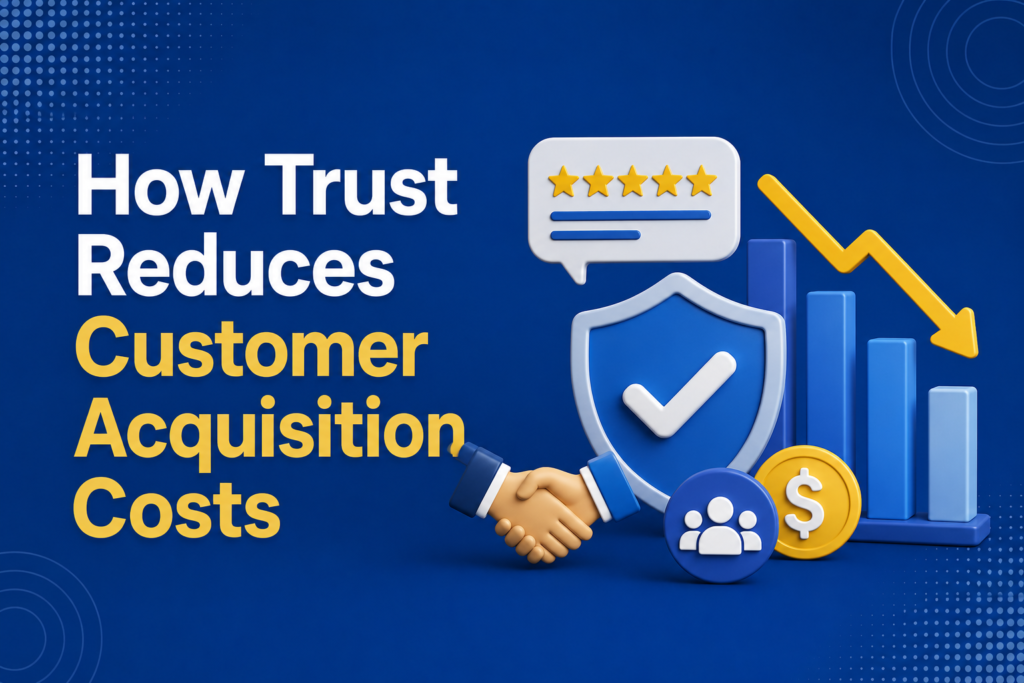
Customer acquisition cost is the total amount a business spends to acquire one new customer. In its simplest form it’s calculated by dividing total acquisition spend by the number of customers acquired in the same period. Spend $10,000 and acquire 20 customers and the CAC is $500.
But this definition, while accurate, obscures something important. CAC isn’t just a function of how much is spent. It’s a function of how efficiently that spend converts into customers – and efficiency is determined by how hard it is to get someone to say yes.
A business that converts five percent of its leads into customers has a fundamentally different economics from one converting twenty percent of the same leads. The second business can spend four times less to acquire the same number of customers – or spend the same amount and acquire four times more. The difference between those two businesses isn’t usually the channel, the creative, or the targeting. It’s how easily the audience moves from awareness to decision.
Trust is the primary variable that determines that ease. When a business is trusted, the journey from attention to purchase is shorter, smoother, and cheaper. When it isn’t, every stage of that journey requires more effort, more evidence, more reassurance, and more spend to produce the same result.
CAC, properly understood, is a measure of how hard it is to earn a yes. Trust is what makes yes easier to earn.
How Does Trust Reduce Customer Acquisition Costs?
Trust Reduces Resistance
Every customer acquisition process involves resistance – the friction between a prospect’s initial awareness of a business and their willingness to commit to buying from it.
That resistance takes several forms. Skepticism about whether the business can deliver what it promises. Objections about price, timing, or fit. Hesitation at the point of commitment. Questions that need answering before the decision feels safe. Each of these is a form of resistance, and each one costs something to overcome – time, follow-up, sales effort, and in many cases additional marketing spend to maintain contact with prospects who aren’t yet convinced.
When trust is low, resistance is high. The prospect has no existing reason to believe the business will deliver. Every claim needs verification. Every objection surfaces. Every hesitation requires additional reassurance. The sales process is long, effortful, and expensive – not because the prospect doesn’t want the outcome, but because they don’t yet believe this business will produce it.
When trust is high, resistance drops. The prospect arrives with pre-existing confidence that the business knows what it’s doing and delivers on its promises. Objections are fewer because the trust infrastructure has already answered most of the questions that would otherwise generate them. Hesitation is lower because the perceived risk of committing feels manageable. The sales process is shorter, the conversion is faster, and the cost of producing it is lower.
This is why high-trust businesses can outperform higher-spending competitors. They’re not necessarily reaching more people. They’re encountering less resistance from the people they do reach – and less resistance means lower cost per conversion across every stage of the acquisition process.
Trust Improves Conversion Rates
Conversion rate is the most direct expression of how efficiently a business turns attention into customers. And trust is one of the most powerful levers available for improving it – without changing the traffic source, the ad spend, or the audience.
Consider what happens at each stage of the conversion process when trust is present.
A visitor lands on a website. If the business has built visible trust signals – specific testimonials, documented results, demonstrated expertise, consistent professional presentation – the visitor’s initial skepticism is partially resolved before they’ve read a word of the offer. They arrive in a more receptive state. The threshold they need the offer to clear is lower because the business has already cleared some of it through its trust infrastructure.
A lead receives a follow-up email. If the business has been consistently present – producing genuinely useful content, demonstrating knowledge, showing up reliably – the email from a trusted source lands differently than one from an unknown business asking for attention it hasn’t earned. Open rates are higher. Responses are more engaged. The progression toward a buying conversation is faster.
A prospect evaluates the offer. If the business has specific, detailed proof that the promised outcome has been delivered for people in comparable situations, the evaluation is shorter. The prospect doesn’t need to do as much independent research or seek as many external validations. The trust signals have done that work already.
At every stage, trust reduces the friction that prevents conversion. And friction reduction directly translates to conversion rate improvement. A business that improves its conversion rate from two percent to four percent has halved its customer acquisition cost without changing a single element of its media strategy. That improvement compounds across every channel the business uses and every campaign it runs.
Trust Increases Referral Growth
Referrals are the most cost-efficient customer acquisition channel available to most businesses – and they are entirely a product of trust.
A referral arrives differently from any other lead. They haven’t been reached through advertising, haven’t discovered the business through search, and haven’t stumbled across the content through social media. They’ve been sent by someone who knows them, understands their situation, and believes this specific business is the right solution for their specific problem. That introduction carries a weight that no paid channel can replicate.
The trust that would normally take weeks or months to build through content, proof, and consistent presence has been partially transferred in a single recommendation. The referred lead arrives predisposed to believe, predisposed to engage, and predisposed to buy. Their resistance is lower from the first interaction. Their sales cycle is shorter. Their conversion rate is higher.
The economics are significant. A referred customer typically costs a fraction of what a customer acquired through paid channels costs – because the trust infrastructure that paid acquisition has to build from scratch has already been supplied by the referral. The business doesn’t pay for that trust. The referring customer provided it.
But referrals don’t happen automatically. They are a direct output of how much trust existing customers have in the business – specifically, how confident they are that the business will deliver for someone they care about. Referring a business to a colleague or friend is itself a trust transaction. The referring customer is staking their own reputation on the recommendation. They only make that stake when their confidence in the business is high enough to justify the risk.
This means that investing in trust – through the quality of the work, the consistency of the delivery, the experience of being a customer – is simultaneously an investment in referral generation. Every satisfied customer whose trust has been earned and maintained is a potential referral source. The businesses with the most active referral pipelines are almost always the ones with the strongest trust foundations – not the ones with the most aggressive referral incentive programs.
Trust Creates Repeat Customers
Acquiring a new customer is expensive. Retaining an existing one is dramatically cheaper – and trust is the primary variable that determines whether customers stay or leave.
A customer who trusts the business doesn’t re-evaluate the buying decision with every subsequent purchase. The trust established through the first experience carries forward. The skepticism that characterized the initial acquisition process is largely absent. The resistance is lower. The decision is faster. The cost of generating the repeat purchase is a fraction of the cost of generating the first one.
This has a direct and significant effect on overall acquisition economics. Customer lifetime value – the total revenue a customer generates over the full period of their relationship with the business – is the denominator that puts acquisition cost in its proper context. A customer acquired for five hundred pounds who buys once represents a five-hundred-pound acquisition cost against a single purchase. The same customer who buys four times over two years represents the same acquisition cost against four purchases – effectively reducing the per-transaction acquisition cost by seventy-five percent.
Trust is what makes the second, third, and fourth purchases happen. Not discounts, not loyalty programs, not automated re-engagement campaigns – though these can help at the margins. The fundamental driver of repeat purchase is the customer’s confidence that the business will deliver again what it delivered before. That confidence is trust. And trust, once earned through a positive first experience, is one of the most durable assets a business can hold.
The businesses with the lowest effective acquisition costs are often the ones with the highest retention rates – not because they’re spending less to acquire, but because they’re spreading that acquisition cost across more transactions, more referrals, and more lifetime value per customer.
Trust Reduces Price Sensitivity
Price sensitivity – the degree to which a customer’s buying decision is influenced by price – is not a fixed characteristic of any market. It’s a variable, and trust is one of the most significant factors that determines where it sits.
When trust is low, price becomes the primary basis for comparison. The customer can’t confidently evaluate quality, reliability, or outcome – because they have no established reason to believe any business’s claims over any other’s. So they compare what they can compare: the number on the price tag. The lowest price feels like the lowest risk, because at least the downside is limited if the business fails to deliver.
When trust is high, the calculation changes. The customer isn’t comparing unknown quantities anymore. They’re evaluating a business they have reason to believe will deliver – through its demonstrated expertise, its specific proof, its consistent reputation. In that context, price becomes a secondary consideration. The question shifts from “who is cheapest?” to “is the outcome worth the investment?” And for a business whose trustworthiness is established, that question is far easier to answer favorably.
This dynamic has direct implications for acquisition cost. A business that competes on price to overcome low trust is accepting reduced margins on every sale – which means it needs more sales to generate the same revenue, which means higher total acquisition spend for the same outcome. A business that commands premium prices through high trust generates more revenue per customer acquired, which means the same acquisition spend produces a more profitable result.
Trusted businesses discount less. They close at higher prices. They attract customers who are choosing based on confidence in the outcome rather than sensitivity to the cost. Each of these effects improves the economics of acquisition – not by reducing spend, but by increasing the return on every pound or dollar spent.
Trust Compounds Over Time
Paid advertising produces results while the spending continues and stops when it doesn’t. The moment the budget is cut, the visibility disappears, the leads stop arriving, and the acquisition engine goes quiet.
Trust works differently. It accumulates. And accumulated trust keeps producing results long after the work that built it was done.
A detailed case study published today will still be building credibility for prospects who find it in eighteen months. A body of genuinely useful content will still be attracting qualified search traffic two years after it was written. A reputation built through consistent delivery and word of mouth will still be generating referrals from customers whose trust was earned three years ago. None of these require ongoing spend to keep working. They are assets, not expenses – and unlike media spend, they appreciate rather than depreciate over time.
This compounding quality is what makes trust the most capital-efficient investment available in customer acquisition. Early investments in trust – building proof, developing expertise, creating genuinely useful content, delivering consistently – produce returns that grow over time rather than remaining fixed. The business that invested in trust two years ago is acquiring customers today at a lower cost than it was then, because the trust infrastructure built then is doing more work now than it was when it was first created.
Contrast this with a business that has invested exclusively in paid acquisition. Its CAC today is roughly what it was two years ago – or higher, because media costs increase over time and audiences become more saturated. There is no compounding. Every customer costs approximately what the last one cost. The treadmill runs at the same speed regardless of how long the business has been on it.
The Trust-CAC Flywheel
The relationship between trust and customer acquisition cost isn’t linear – it’s a flywheel. Each rotation makes the next one easier and more efficient.
More trust produces higher conversion rates – because the resistance between awareness and purchase is lower, and the proportion of people who encounter the business and decide to buy is higher.
Higher conversion rates produce lower acquisition costs – because the same spend generates more customers when a higher percentage of leads convert.
Lower acquisition costs produce more customers – because the budget that previously generated ten customers now generates fifteen, and the margin freed up by lower CAC can be reinvested in reaching more people.
More customers produce more proof – more testimonials, more case studies, more documented results, more word of mouth from satisfied buyers whose experience validates the business’s claims.
More proof produces more trust – because the evidence that the business delivers on its promises is now broader, more specific, and more convincing to the next prospect evaluating whether to buy.
And the flywheel completes its rotation. More trust. Higher conversion. Lower cost. More customers. More proof. More trust.
Each rotation compounds the last. The flywheel that is difficult to push at the beginning – when trust is low, proof is sparse, and conversion rates reflect the skepticism of a market that doesn’t yet know the business – becomes progressively easier to push as each element strengthens the others.
This is why businesses with strong trust foundations seem to grow more easily than ones without them. It isn’t that the market is kinder to them or that their product is categorically superior. It’s that the flywheel is already spinning – and a flywheel in motion requires far less energy to maintain than one that hasn’t started yet.
The Most Overlooked Growth Lever
Businesses looking to reduce customer acquisition costs typically look at channels, targeting, creative, and bidding strategies. These are legitimate places to look and improvements in any of them can produce meaningful results.
But the most consistent, most durable, and most compounding lever available for reducing acquisition cost isn’t in the media plan. It’s in the trust infrastructure – the proof, the expertise, the consistency, the reputation, and the customer experience that determine how easily the market says yes.
Becoming a business that customers already trust before they buy doesn’t just make marketing easier. It makes growth cheaper. It reduces the resistance at every stage of acquisition. It improves conversion without increasing spend. It generates referrals that arrive pre-convinced. It retains customers who become advocates. It commands prices that don’t require discounting to close.
Every investment in trust is an investment in lower acquisition costs – not immediately, and not visibly in a weekly dashboard, but durably and compoundingly over time in ways that paid spend alone never achieves.
The businesses that figure this out stop treating trust as a brand consideration and start treating it as an acquisition strategy. Because that’s exactly what it is.