A lot of people measure lead generation success by volume.
The campaign generated 50 leads. The content brought in 200 enquiries. The ad produced 30 form submissions. The numbers go up and the assumption is that things are working.
But volume is the wrong metric. And optimizing for it is one of the most expensive habits in customer acquisition.
Because 50 leads where 3 are qualified outperforms 200 leads where none are – not just in conversion rate, but in every downstream metric that actually matters. Revenue. Time spent. Cost per acquisition. Team morale. The quality of the data you’re using to make future decisions.
The goal of lead generation was never to generate more leads. It was always to generate better ones. The businesses that understand this distinction build systems that produce consistent, predictable revenue. The ones that don’t stay trapped in a cycle of high activity and disappointing results – generating enquiries, chasing prospects, closing almost nothing, and concluding that they need to generate even more leads next time.
The answer is almost never more leads. It’s better ones.
Why Most Businesses Focus on the Wrong Lead Metric
Volume is visible. Quality isn’t.
A dashboard that shows fifty new leads this month feels better than one showing ten – regardless of what those fifty leads actually represent. The number is concrete, trackable, and easy to celebrate. Whether those fifty people have the problem you solve, the budget to pay for the solution, and any genuine intention to act is a harder question, and one that doesn’t fit neatly into a reporting slide.
This is why businesses default to quantity metrics. They’re easier to measure, easier to report, and easier to optimize for. Run broader targeting and lead volume goes up. Lower the barrier to entry on a lead magnet and more people download it. Widen the audience on a paid campaign and more people click through.
What also goes up, silently, is the percentage of those leads that will never buy.
The problem compounds over time. A business optimizing for lead volume gradually builds a pipeline full of poor fits – people who were never going to buy, who consume time in follow-up calls and email sequences, who skew conversion data, and who create a distorted picture of what’s actually working. Decisions get made based on that distorted picture. More budget goes to the channels producing the most leads rather than the best ones. The cycle continues.
Breaking it requires a willingness to accept fewer leads in exchange for better ones – a trade that feels counterintuitive until you’ve seen what it does to revenue and efficiency on the other side.
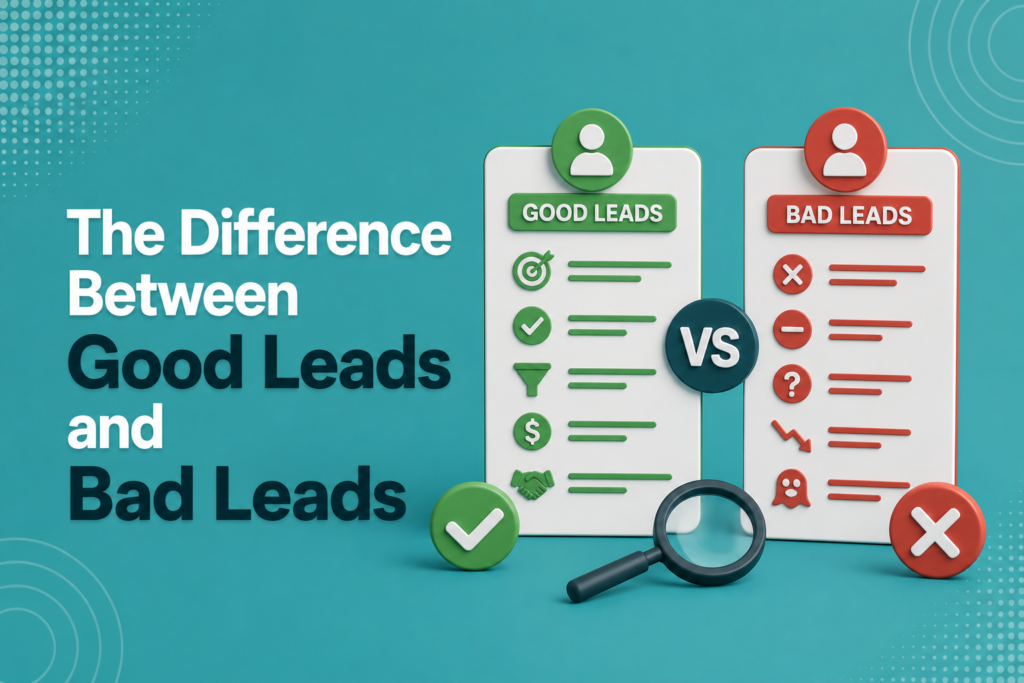
What Makes a Lead Good
A good lead isn’t just someone who expressed interest. Interest is the beginning of the evaluation, not the conclusion of it.
A good lead meets four criteria simultaneously. Remove any one of them and the lead may still be worth nurturing – but it isn’t ready to convert, and treating it as if it is wastes resources that should be going to leads that are.
The first criterion is a real, recognized problem. The lead has a problem your product or service solves – and they know they have it. They’ve named it, felt its cost, and decided it’s worth resolving. A lead who has the problem but hasn’t recognized it yet isn’t a bad lead – they’re an early-stage lead who needs education before they’re ready for a buying conversation. Pushing them toward a decision before that recognition has happened produces resistance rather than revenue.
The second criterion is desire for the outcome. Having a problem isn’t enough. The lead has to want the specific outcome your offer produces – not a vaguely related outcome, not an outcome adjacent to the one you deliver, but the actual result your product is designed to create. A lead who wants to grow their business generally but has no specific interest in the mechanism your product uses to achieve that isn’t a good fit, regardless of how much they engage with your content.
The third criterion is ability to pay. A lead who loves your offer but genuinely cannot afford it is not a qualified lead – they’re a person with a problem and no budget. This isn’t a judgment about their value as a person. It’s a practical recognition that time spent nurturing someone who will never be able to buy is time taken from someone who can. Budget qualification is one of the most consistently skipped steps in lead evaluation – and one of the most expensive to ignore.
The fourth criterion is likelihood to act. Some leads have the problem, want the outcome, and can afford the solution – but have no real intention of doing anything about it in the near term. They’re researchers, browsers, or people who are interested in the topic without being motivated to solve the problem right now. These leads aren’t worthless – timing can change – but they aren’t ready for a sales conversation, and treating them as if they are produces frustration on both sides.
When all four criteria are present, the lead is genuinely worth pursuing. The conversion process still requires work – trust, clarity, offer quality, and friction all still matter. But the foundation is there. The raw material of a customer exists.
What Makes a Lead Bad
A bad lead isn’t necessarily a bad person or even a permanently unqualified one. It’s a lead that doesn’t meet one or more of the criteria above – and therefore isn’t ready, able, or likely to buy what you’re selling right now.
The most common types of bad leads follow predictable patterns.
The wrong audience is the most fundamental. These are people who found your content interesting or clicked on your ad but don’t actually have the problem you solve. They might be students, competitors, people with adjacent interests, or simply people who engaged with a piece of content that was too broad to attract a qualified audience. Wrong-audience leads look like leads in a dashboard. They behave like leads in the early stages of a funnel. And then they consistently fail to convert – because the fit was never there to begin with.
No urgency leads have the problem but aren’t motivated to solve it now. The pain isn’t acute enough. The cost of leaving it unresolved isn’t high enough to drive action. These leads will engage, ask questions, attend webinars, and download resources – and then disappear when the conversation moves toward a buying decision. Urgency can develop over time, which is why these leads are worth staying in contact with. But they shouldn’t be treated as conversion-ready until something in their situation changes.
No budget leads are exactly what they sound like. The desire is real and the problem is genuine – but the financial means to buy the solution don’t exist at the level required. Sometimes this is a temporary condition. Sometimes it’s permanent. Either way, a lead without budget cannot become a customer regardless of how well the sales process goes.
No authority leads are more relevant in B2B contexts – the person engaging with your marketing isn’t the person who makes the buying decision. They might be a junior team member, a researcher, or someone who influences the decision without controlling it. These leads can be valuable as internal advocates – but they cannot close the sale themselves, and treating them as decision-makers wastes time that should go to the people who actually hold the budget and authority.
No real problem leads are the most expensive of all. These are people who fit your target demographic perfectly on paper but don’t actually experience the problem your product solves. They might have downloaded a lead magnet out of general curiosity. They might have clicked an ad that was compelling without being relevant to their situation. Whatever the reason, there’s no genuine need underneath the interest – and no amount of follow-up will create one where it doesn’t exist.
Why Bad Leads Cost More Than You Think
The cost of bad leads is rarely calculated honestly – because most of it is invisible.
The visible cost is easy enough to see. Ad spend that generated enquiries from people who were never going to buy. Time on discovery calls with prospects who weren’t qualified. Follow-up sequences sent to contacts who had no real intention of converting. These costs are real and they add up.
But the invisible costs are larger.
Bad leads distort performance data in ways that produce bad decisions. When a significant percentage of the leads in a pipeline are unqualified, conversion rates look worse than they actually are for qualified leads. A business might conclude that its offer is weak, its pricing is too high, or its sales process is broken – when the real problem is that the leads being measured were never going to buy regardless of offer quality, price, or sales skill. Decisions get made to fix the wrong things, which makes the problem worse rather than better.
Bad leads consume sales capacity that should go to good ones. Every hour spent on an unqualified discovery call is an hour not spent on a qualified one. Every follow-up sequence running to a dead-end lead is automated attention not going to a live prospect. In businesses with limited sales resources – which is most small businesses – this opportunity cost is enormous. The qualified leads that do exist get less attention because the unqualified ones are consuming the available bandwidth.
Bad leads damage team confidence. A salesperson or founder who spends week after week on calls that go nowhere starts to doubt the product, the pricing, the market, and themselves. The psychological cost of consistent rejection – even rejection from leads that were never qualified – accumulates into a kind of learned helplessness that affects how confidently the offer gets presented to the qualified leads that do come through.
Bad leads produce misleading signals about marketing performance. A channel that generates high volume of poor-quality leads looks successful in a volume-based reporting system. Budget flows to it. The channel that generates lower volume of high-quality leads looks like it’s underperforming. Budget gets cut. The result is a marketing mix increasingly optimized for the wrong outcome – more leads, worse quality, lower revenue.
The full cost of bad leads isn’t just what they consume directly. It’s what they prevent – the decisions not made correctly, the qualified leads not pursued fully, the confidence not maintained, the budget not allocated to what actually works.
Why Businesses Attract Poor-Quality Leads
Poor lead quality is almost always a symptom of something upstream – a problem in positioning, targeting, or offer clarity that is attracting the wrong people before the lead generation process even begins.
Vague targeting is the most common root cause. When a business hasn’t defined its ideal customer with enough precision, its marketing casts a wide net that catches a wide variety of people – most of whom aren’t a fit. Broad targeting feels safer because it feels like more opportunity. In practice it produces more of the wrong conversations and fewer of the right ones.
Weak positioning compounds the targeting problem. A business without a clear, specific position attracts a diffuse audience – people who found the content interesting for a variety of reasons, only some of which are connected to the problem the business actually solves. Strong positioning – specific about who it’s for, what problem it addresses, and what outcome it produces – functions as a filter. It attracts the right people and makes the wrong people self-select out before they enter the funnel.
Generic lead magnets are one of the most consistent generators of poor-quality leads. A lead magnet designed to maximize downloads attracts the broadest possible audience – which is also the least qualified one. A free guide titled “10 Marketing Tips for Any Business” will generate far more downloads than one titled “How Independent Consultants Can Generate Consistent Client Enquiries Without Referrals” – and far fewer qualified leads. The trade-off is always worth making.
Broad messaging at the awareness stage attracts broad audiences. Content that speaks to everyone speaks compellingly to no one – and the people it attracts are a random sample of the internet rather than a curated audience of potential customers. The more specifically the content is written for a defined person with a defined problem, the more precisely it filters at the point of first contact.
How to Attract More Good Leads
Improving lead quality is not primarily a tactical problem. It’s a positioning and targeting problem – and it’s solved upstream, before the lead generation mechanics even come into play.
The starting point is a precise definition of what a good lead actually looks like for your specific business. Not a demographic sketch – a behavioral and situational one. What problem are they experiencing? How acutely are they feeling it? What have they already tried? What outcome are they specifically looking for? What budget range makes sense for the solution? What signals indicate they’re ready to act rather than just browse?
With that definition in place, every element of the lead generation system can be evaluated against it. Does the content attract people who match that definition? Does the lead magnet appeal specifically to them rather than to a broader audience? Does the positioning signal that the business is specifically for them? Does the targeting on paid channels reach them rather than a broader demographic that happens to overlap with them?
Positioning is the highest-leverage adjustment available. A business that sharpens its positioning – narrows its stated audience, specifies its problem, clarifies its outcome – will typically see lead volume decrease and lead quality increase simultaneously. The decrease in volume is temporary and often smaller than expected. The increase in quality is permanent and compounds over time as the right audience begins to self-select in and refer others who match their profile.
Offer clarity filters at the point of conversion. A specific, well-constructed offer – one that names a precise problem, promises a defined outcome, and makes clear who it’s designed for – repels poor fits before they become leads. A vague offer accepts everyone and qualifies no one. The qualification work then falls to the sales process, which is the most expensive place to do it.
Trust signals attract serious leads and deter casual ones. Detailed case studies, specific testimonials, and demonstrated expertise signal that this business works with clients who take their problems seriously and are prepared to invest in solving them. That signal self-selects for qualified leads – because the people it appeals to are the ones who recognize themselves in the proof.
How to Evaluate Lead Quality: A Simple Checklist
Before investing significant time in any lead, run it through these eight questions. The answers tell you whether the lead is worth pursuing now, worth nurturing for later, or worth releasing entirely.
Do they have the specific problem your offer solves? Not a related problem, not a vague dissatisfaction – the precise problem your product or service addresses. If the answer is unclear, find out before investing further.
Have they recognized and named the problem themselves? A lead who has the problem but hasn’t acknowledged it yet isn’t ready for a buying conversation. They need education first. Pushing them toward a decision before that recognition exists produces resistance.
Do they want the specific outcome your offer produces? The desired outcome has to match what you actually deliver – not a version of it, not something adjacent to it. Mismatches here produce sales that end in refunds or unhappy clients.
Can they afford the solution? This question feels uncomfortable to ask directly, which is why most businesses don’t ask it – and why they waste time on leads that were never going to convert. Find a way to qualify budget early. It saves everyone time.
Do they have the authority to make the buying decision? In B2B contexts especially, the person engaging with your marketing may not be the person who approves the purchase. Knowing early whether you’re talking to a decision-maker or an influencer changes how you approach the conversation.
Is there urgency? Are they looking to solve this problem now, or are they researching for a future decision? Urgency doesn’t disqualify a lead that lacks it – but it changes the priority level and the appropriate follow-up approach.
Have they engaged with your content or proof specifically? A lead who has read your case studies, consumed your educational content, or spent meaningful time understanding your approach is more qualified than one who clicked a single ad. Depth of engagement is a proxy for seriousness.
Do they fit the profile of your best existing customers? Your best customers – the ones who got the most from working with you, stayed longest, referred others – are the template for your ideal lead. The closer a new lead resembles that template, the higher the probability of a similar outcome.
A lead that passes all eight checks is worth prioritizing immediately. One that passes most but fails on urgency or timing is worth nurturing. One that fails on problem fit, budget, or authority is worth releasing – because the time spent on it has a direct opportunity cost measured in qualified leads not pursued.
Lead generation that produces twenty leads passing all eight checks will outperform lead generation producing two hundred leads that fail most of them. Every time. Not because volume doesn’t matter – it does – but because quality is the multiplier that determines what volume is actually worth.
The businesses that figure this out stop asking how to generate more leads. They start asking how to generate better ones. And that question leads somewhere completely different.