Most businesses with a conversion problem don’t have a product problem.
They have an offer problem.
An offer is the promise you make, the outcome you deliver, and the terms under which you deliver it
The distinction matters more than most business owners realize. A product is what you build. An offer is what you sell. And the gap between those two things – between having something genuinely valuable and presenting it in a way that makes people want to buy it – is where most revenue gets lost.
The frustrating part is that a weak offer rarely feels weak from the inside. The business owner knows the product is good. They’ve seen it work. They understand the value it delivers. It seems almost impossible that someone could encounter it and not immediately want it.
But the customer isn’t seeing what the business owner sees. They’re seeing a presentation – a combination of words, structure, proof, and framing – and making a rapid judgment about whether it’s worth their attention, their trust, and their money. If that presentation doesn’t answer the right questions in the right sequence, the product underneath it doesn’t get a chance to prove itself.
This article is about what a high-converting offer actually contains – the specific components that separate offers that convert consistently from ones that get ignored despite the quality of the product behind them.
Why Great Products Still Struggle to Sell
The belief that a good product sells itself is one of the most expensive myths in business.
It occasionally comes true – in closed networks where reputation travels through personal relationships, or in categories where the product is so demonstrably superior that comparison is immediate and obvious. But in the open, competitive environment of online business, where the customer is encountering dozens of options and making rapid judgments with incomplete information, quality alone is rarely enough.
The reason is simple. The customer cannot experience the product before buying it. They’re making a decision based on how the product is presented – the promise being made, the evidence supporting that promise, the clarity of the outcome, the perceived risk of committing. If any of those elements is weak, the product never gets the chance to demonstrate its quality.
This is why two businesses can offer essentially the same service and produce dramatically different results. One has built an offer that answers every question the customer is asking before they ask it. The other is relying on the quality of the underlying service to carry a presentation that isn’t doing its job.
The offer is the bridge between what you’ve built and what the customer is willing to buy. A weak bridge means most people never cross it – regardless of how good the destination is.
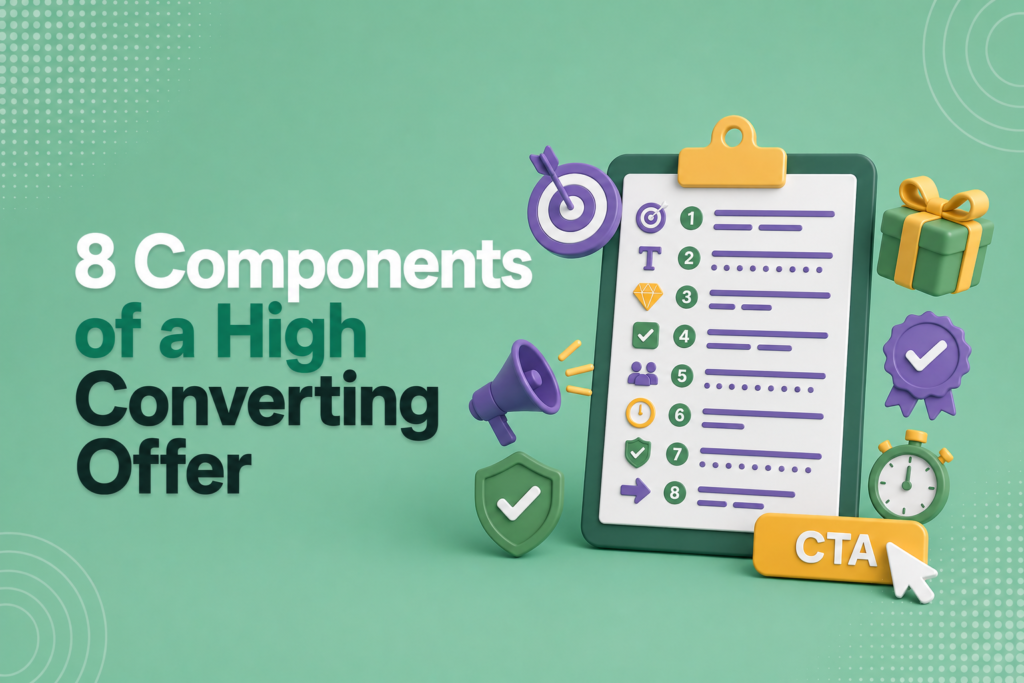
The Components of a High Converting Offer
1. A Clear Problem
Every compelling offer begins with a problem the customer already recognizes as real and worth solving.
Not a problem the business thinks the customer should have. Not a problem adjacent to the one the customer is actually experiencing. The specific, named problem that the customer wakes up thinking about, that is costing them something measurable – time, money, opportunity, peace of mind – and that they have already decided they want to resolve.
This component is often skipped because it feels unnecessary. The business assumes the customer already knows they have the problem. Sometimes they do. But more often, the customer has a vague sense of discomfort that hasn’t yet been crystallized into a specific, nameable problem – and an offer that names it clearly does something powerful. It creates the feeling of being understood before anything has been sold.
When a customer reads an offer and thinks “that’s exactly what I’m dealing with” – before they’ve even looked at the solution – the offer has already cleared the most important psychological barrier. The customer is now receptive in a way they weren’t a moment before. Not because they’ve been persuaded, but because they feel recognized.
The practical implication is that offer copy should lead with the problem in the customer’s own language – not the business’s internal terminology, not industry jargon, not a reframing the customer hasn’t arrived at yet. The words the customer uses privately to describe their frustration are the words that should appear at the beginning of the offer.
2. A Valuable Outcome
If the problem is what the customer is moving away from, the outcome is what they’re moving toward – and the quality of that outcome determines how motivated they are to buy.
Most offers describe outputs rather than outcomes. An output is what the customer receives: a twelve-week coaching program, a website redesign, a content strategy document, fifty email sequences. An outcome is what changes as a result: consistent client enquiries without relying on referrals, a website that converts visitors into leads, content that builds authority with the right audience, an email system that generates revenue while the founder sleeps.
Outputs describe what the business delivers. Outcomes describe what the customer gains. People don’t buy outputs. They buy outcomes – and the more specifically and vividly those outcomes are described, the more compelling the offer becomes.
The specificity of the outcome also determines its believability. “Better results” is not a credible outcome because it can mean anything. “Twenty qualified leads per month within sixty days” is credible because it’s specific enough to be verified and concrete enough to be imagined. The customer can picture what their situation looks like if that outcome is delivered – and that picture is what motivates the buying decision.
Outcome specificity also does something else: it filters. An outcome described in general terms attracts general interest from people who may or may not be a fit. An outcome described with precision attracts specific interest from people who want exactly that – and repels people for whom it isn’t relevant. That filtering effect improves lead quality and conversion rate simultaneously.
3. Specificity
Specificity is not a single component so much as a quality that runs through every other component – but it deserves its own examination because it’s the element most consistently absent from weak offers.
Vague offers don’t convert. Not because customers are skeptical of vague claims – though they are – but because vague claims don’t give the customer enough information to make a decision. A decision requires a clear picture of what is being exchanged: what the customer gives up, what they receive, and what changes as a result. Vagueness obscures that picture and forces the customer to fill in the gaps with their own assumptions – which are almost always more conservative than the reality.
Specificity operates across every dimension of an offer. Specific about who it’s for: not “business owners” but “service-based business owners with an established client base who want to replace referral dependency with a consistent inbound system.” Specific about what’s included: not “comprehensive support” but the exact deliverables, the exact timeline, the exact format of each element. Specific about the outcome: not “grow your business” but the measurable change the customer can expect and the timeframe in which they can expect it.
Each layer of specificity does two things simultaneously. It makes the offer more compelling to the people it fits – because they can see themselves in it clearly. And it makes the offer less relevant to the people it doesn’t fit – which is equally valuable, because unqualified prospects waste time and dilute conversion data.
Specificity is the mark of a business that knows exactly what it does, who it does it for, and what it produces. That confidence, communicated through the precision of the offer, is itself a trust signal before a single testimonial has been read.
4. Differentiation
A compelling offer doesn’t just describe what it delivers. It answers the question every customer is asking when they compare options: why this, rather than the alternatives?
Without a clear answer to that question, the customer defaults to the variables they can compare most easily – price, familiarity, and convenience. None of these favor a business that hasn’t established itself as the obvious choice. Price competition erodes margins. Familiarity favors whoever arrived first. Convenience favors whoever is easiest to find.
Differentiation in an offer doesn’t require doing something that no competitor does. It requires being clearer than competitors about who the offer is specifically for, what makes the approach distinct, and what the customer gets that they wouldn’t get elsewhere. Sometimes that distinction is methodological – a proprietary process that produces results in a specific way. Sometimes it’s audience-specific – a deep specialization in a particular type of customer or problem. Sometimes it’s in the guarantee structure or the delivery format or the level of access provided.
What matters is that the differentiation is real, specific, and communicated in terms the customer can evaluate. “We’re different because we care more” is not differentiation – it’s a claim every business makes and no customer can verify. “We’re the only agency that works exclusively with independent financial advisors and guarantees a specific number of qualified appointments within ninety days or you don’t pay for month two” is differentiation – specific, verifiable, and meaningful to the right customer.
The differentiation component of an offer is what makes the choice feel active rather than arbitrary. Without it, the customer isn’t really choosing you. They’re just landing on you by default.
5. Risk Reduction
Every purchase involves a moment of hesitation – the point at which the customer has decided they want the outcome but hasn’t yet decided that the risk of buying is acceptable.
This moment is where more offers fail than at any other point. Not because the customer changed their mind about the value, but because the perceived risk of getting it wrong – wasting money, wasting time, making a publicly visible mistake – outweighs the confidence they have in the outcome being delivered.
Risk reduction is the component that addresses this directly. It doesn’t eliminate uncertainty – nothing can do that before the purchase. But it restructures the risk in a way that makes the decision feel safer.
The most direct form of risk reduction is a guarantee. Not a vague “satisfaction guaranteed” statement but a specific commitment: if this specific outcome isn’t achieved within this specific timeframe, here is exactly what happens. A guarantee works because it shifts some of the risk from the customer back to the business. The business is now sharing in the downside of a poor outcome rather than collecting payment and leaving the customer to bear it alone. That shared risk signals confidence in the offer – because a business that doesn’t believe in its own results doesn’t offer to refund them if they don’t materialize.
Risk reduction also operates through transparency. A clear description of exactly what the buying experience looks like – what happens after purchase, what the onboarding process involves, what the timeline is, what the customer needs to do and not do – removes uncertainty about the process even when it can’t remove uncertainty about the outcome. Known processes feel less risky than opaque ones, and businesses that describe their process with confidence signal that they’ve done this before and know how it goes.
Social proof functions as risk reduction too. When a customer sees that people in situations similar to their own have taken this risk and been satisfied, the decision feels less lonely and less dangerous. The risk hasn’t disappeared – but it’s now a risk that others have taken and survived, which makes it feel categorically different from a leap into the unknown.
6. Simplicity
Complexity is a conversion killer that most businesses create without realizing it.
An offer that requires significant mental effort to understand – too many options, too many tiers, too many conditions, too many steps to the outcome – creates friction at the exact moment when the customer needs clarity. The brain responds to complexity with hesitation, and hesitation online almost always resolves as inaction.
Simplicity in an offer doesn’t mean stripping out everything that makes it valuable. It means presenting what’s valuable in the most direct and digestible way possible. One clear outcome, not five possible ones. One recommended option, not a menu of tiers that forces the customer to make a secondary decision before they’ve committed to the primary one. One obvious next step, not a series of branching paths that require navigation.
The paradox of choice – the well-documented finding that more options produce less decision-making rather than better decision-making – is directly relevant here. Customers presented with too many choices frequently choose nothing, not because none of the options appeal to them but because the cognitive cost of choosing between them feels higher than the benefit of any individual option.
Simple offers respect the customer’s cognitive bandwidth. They make the decision feel manageable rather than overwhelming. They present a clear exchange – here is exactly what you give, here is exactly what you get – and leave nothing important ambiguous.
Simplicity is also a positioning signal. A business that can describe its offer simply and clearly has thought carefully about what it actually does and who it actually serves. Complexity in an offer often reflects complexity in the business’s own thinking – an unresolved question about what the product is, who it’s for, or what it produces. Resolving that complexity internally is what makes simplicity in presentation possible.
7. Believability
An offer is only as effective as the customer’s belief that it will deliver what it promises.
This is the component that closes the gap between interest and action. A customer can find an offer relevant, understand the outcome, appreciate the differentiation, and feel the risk has been reduced – and still not buy, because they don’t fully believe the promise will be kept for them specifically.
Believability is built through proof – but proof of a specific kind. Generic testimonials and vague success stories don’t move the believability needle significantly because they can’t be evaluated. A five-star review that says “great experience, highly recommend” tells the customer nothing about whether the outcome described in the offer is real or achievable for someone in their situation.
Specific, detailed proof does. A case study that describes a client whose starting point mirrors the reader’s, walks through the specific approach taken, and documents the specific result achieved – that creates believability because the customer can follow the logic. They can see why the result happened, not just that it happened. And a result they can understand the mechanism behind feels replicable in a way that an unexplained result never does.
Numbers strengthen believability when they’re specific and contextualized. “Increased revenue by 40%” is more believable than “significantly improved results” – but “increased monthly recurring revenue from $8,000 to $11,200 within four months for a SaaS business in the project management space” is more believable still, because the specificity signals that the result was real and documented rather than estimated or rounded for effect.
The founder’s own story contributes to believability when it’s relevant. A business owner who has personally navigated the problem they’re now helping customers solve has a different kind of credibility than one who is offering a solution they’ve never needed themselves. That lived experience, communicated specifically rather than generically, does something testimonials alone cannot – it makes the business feel like it comes from the inside of the problem rather than the outside.
8. A Compelling Reason to Act Now
A customer who has evaluated an offer, found it relevant, believed the outcome, and decided the risk is acceptable still has one more decision to make: whether to act now or later.
Default human behavior is to defer. Not because the offer isn’t compelling – but because commitment requires energy, and energy is easier to conserve than to spend. “I’ll come back to this” is the most common conversion killer in online business, and it almost never means the customer will actually come back. It means the moment has passed and the decision will be remade from scratch – if it’s made at all.
A compelling reason to act now doesn’t manufacture urgency where none exists. Fake countdown timers, artificial scarcity, and manufactured deadlines have become so common that most customers recognize and discount them immediately. When the urgency is fake, the trust damage extends beyond the offer to the business overall.
Real urgency comes from real constraints – a cohort that starts on a specific date and won’t be held, a price that increases after a defined period because the business’s costs are increasing, a limited number of client spots because the service requires meaningful individual attention. These constraints are honest, and customers sense the difference between genuine scarcity and manufactured pressure.
Urgency also comes from the cost of delay – a different and often more powerful framing. Rather than “act now because the offer disappears,” the argument is “act now because every month you don’t is costing you something specific.” A business generating twenty fewer qualified leads per month than it could be is losing real revenue every month the problem goes unresolved. Naming that cost – specifically and honestly – creates urgency that is real, because it’s grounded in the customer’s actual situation rather than an artificial deadline.
How to Evaluate Your Own Offer
Understanding the eight components is the conceptual work. Applying them to your own offer requires honest evaluation – which is harder than it sounds when you’re close to the thing you’ve built.
The following questions function as a diagnostic. Answer them from the perspective of a customer encountering your offer for the first time, with no prior context and no existing relationship with your business.
Does the offer name a specific problem in language my customer would use? If you had to describe the problem your offer solves in one sentence using only words your customer would choose, could you do it? If the answer requires industry terminology or internal framing the customer wouldn’t naturally use, the problem statement needs work.
Is the outcome specific enough to be imagined? Can a customer read your outcome statement and picture what their situation looks like after the result is delivered? If the outcome is described in terms of features or outputs rather than changes in the customer’s life or business, it isn’t specific enough.
Would a stranger immediately understand who this is for? Show your offer to someone who doesn’t know your business and ask them who they think the intended customer is. If they struggle to answer precisely, the audience specificity needs sharpening.
Is there a clear reason to choose this over the most obvious alternative? Not over every competitor – over the most obvious one. If you can’t articulate in one or two sentences why a customer who is also considering that alternative should choose you, the differentiation isn’t clear enough.
What happens if it doesn’t work? If your offer doesn’t include an explicit answer to this question, the customer is filling in the gap with their own assumption – which is almost always more pessimistic than the reality. Name what happens. Make it specific. Make it reassuring.
Can the offer be understood in thirty seconds? Read your offer description aloud and time it. If thirty seconds isn’t enough to communicate the problem, outcome, and next step clearly, the offer is more complex than it needs to be.
What proof exists that this outcome has been delivered before? List the specific, detailed evidence you have. If the list consists of generic testimonials or vague success references, the believability component needs work. If the list is empty, building proof is the most urgent priority in your entire customer acquisition system.
Why should the customer act now rather than in three months? If you can’t answer this question with something real – a genuine constraint, a genuine cost of delay – either find the real reason or build the offer in a way that creates legitimate urgency. If the only answer is “because we want the sale,” that’s not an answer the customer will find compelling.
An offer that passes all eight of these questions isn’t guaranteed to convert – distribution, trust, and targeting still matter. But an offer that fails any of them has an identifiable, fixable problem that no amount of traffic or promotion will compensate for.
Fix the offer first. Everything else works better when the foundation is right.