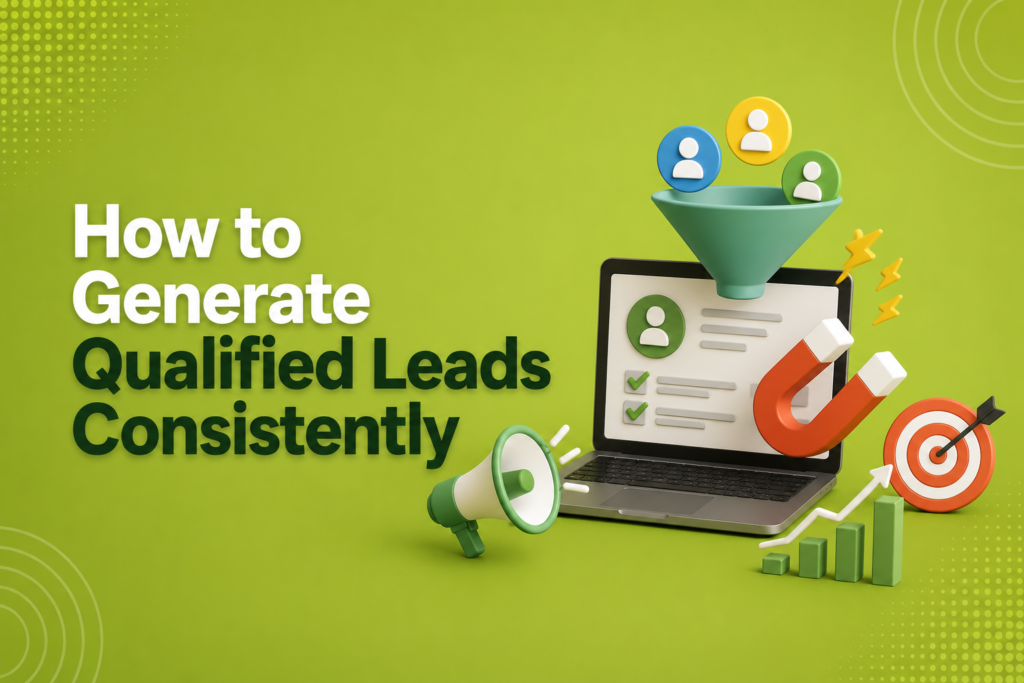
There is a difference between “Leads” and “qualified leads.”
Many businesses say: “We need more leads.”
But what they actually need is more qualified leads.
Because one qualified lead – someone who has the problem you solve, wants the solution you offer, can afford what you charge, and is reasonably close to making a decision – is often worth more than a hundred people who vaguely expressed interest and disappeared.
This is the distinction most lead generation advice misses entirely. The conversation defaults to volume. More traffic. More opt-ins. More form submissions. More enquiries. The assumption is that if you pour enough people into the top of the funnel, enough of them will eventually buy.
Sometimes that’s true. But it’s an expensive, inefficient way to run a business – and it creates a specific kind of exhaustion that many business owners know well. You’re busy. You’re responding to enquiries, getting on calls, following up with prospects. But very little of it converts. The leads aren’t bad people. They’re just not the right people.
Fixing a lead quality problem by chasing lead quantity is not the way to go. The answer isn’t more – it’s better. Better targeting, better messaging, better systems for attracting people who actually fit what you offer and filtering out the ones who don’t.
This article is about building that system.
What is a Qualified Lead?
Before fixing a lead generation problem, it helps to be precise about what you’re actually trying to generate.
A qualified lead is not just someone who expressed interest. Interest is cheap. People click on things, download resources, fill in forms, and follow accounts without any serious intention to buy. None of that makes them a qualified lead.
A qualified lead is a person or business that matches your ideal customer profile, has a problem you can solve, values the outcome you provide, and is likely to take the next step toward becoming a customer.
They have the problem your product or service solves. Not a vaguely related problem, not a problem adjacent to the one you address – the actual problem. If you sell a tool that helps e-commerce businesses recover abandoned carts, a qualified lead is someone running an e-commerce business with a meaningful abandoned cart rate. Not someone who runs a service business and found your content interesting.
They want a solution. Having a problem isn’t enough. Some people have problems they’ve decided to live with – either because they don’t believe a solution exists, because they’ve tried before and it didn’t work, or because the problem isn’t painful enough yet to motivate action. A qualified lead doesn’t just have the problem. They’re actively looking for or open to a solution.
They can afford what you offer. A prospect who loves your service but genuinely cannot pay for it is not a qualified lead – they’re a person with a problem and no budget. This isn’t about gatekeeping. It’s about focus. Time spent nurturing prospects who will never be able to buy is time taken away from people who can.
They’re reasonably likely to act within a relevant timeframe. Someone who might buy in three years is a future prospect, not a current lead. A qualified lead is someone whose urgency, situation, or decision-making timeline makes a purchase plausible in the near to medium term.
When all four criteria are met, you have someone worth investing time and attention in. When one or more is missing, you have an unqualified lead – and the most common lead generation mistake is treating unqualified leads as if qualification were just a matter of trying hard enough.
It isn’t. A prospect who doesn’t have the budget won’t suddenly find it because you followed up six more times. A prospect who doesn’t truly want a solution won’t be argued into wanting one. Qualification is about identifying fit, not creating it where it doesn’t exist.
Why Most Businesses Struggle to Generate Qualified Leads
The reasons businesses generate unqualified leads instead of qualified ones are consistent enough to follow a pattern.
Wrong Audience
The most fundamental lead quality problem is a targeting problem.
The business is visible to the wrong people. Its content attracts an audience that finds it interesting but has no real need for what it sells. Its ads reach demographics that look right on paper but don’t behave like buyers. Its social media following is full of peers, competitors, and casual observers rather than potential customers.
This happens gradually and often invisibly. A business starts posting content, gets engagement, grows a following, and concludes that things are working – without ever checking whether the people engaging are actually the people who buy. Engagement metrics don’t distinguish between a potential customer and someone who just found the content entertaining. Revenue does.
Weak positioning
Even when the right people find a business, weak positioning prevents them from self-identifying as potential leads.
Positioning is the signal that tells a specific person whether this business is for them. Strong positioning makes the right people feel immediately seen and makes the wrong people quickly realize this isn’t for them. That second effect is as valuable as the first – a business that repels bad fits efficiently spends less time on unqualified conversations.
Weak positioning – vague, generic, trying to appeal to everyone – does neither. It attracts a broad, unfocused audience, generates surface-level interest from many people, and converts poorly because nobody feels specifically addressed.
Poor lead magnets and Entry Offers
Many businesses use lead magnets – free resources, guides, checklists, trials – that attract the wrong people.
A lead magnet that appeals to everyone generates leads from everyone. A free guide titled “10 Marketing Tips for Any Business” will attract a wide range of people, most of whom have nothing in common with each other and don’t fit any specific customer profile. A free guide titled “How to Reduce Customer Churn in a SaaS Business with Under 50 Employees” will attract a much smaller number of people – but almost all of them will be potential customers.
Volume drops. Quality rises. That’s the trade-off most businesses are afraid to make, and it’s the one that changes everything.
No Trust Foundation
Qualified prospects – people who genuinely have the problem, want the solution, and have the budget – are more selective, not less.
They’ve usually looked at multiple options. They’ve been burned before by promises that didn’t deliver. They ask harder questions and take longer to commit. A business without a strong trust foundation loses these prospects to competitors who have built credibility more deliberately.
The unqualified prospects – the browsers, the curious, the ones with no real intention to buy – are often easier to attract precisely because they have lower standards. They’ll give you their email address for almost anything. The qualified ones won’t.
No Lead Generation System
The final reason is simply the absence of a deliberate, connected system.
Many businesses generate leads reactively – through referrals when they happen, through content when they post it, through ads when they run them. There’s no consistent mechanism that reliably attracts qualified people, captures their interest, builds their trust, and moves them toward a buying conversation.
The result is feast and famine. Busy periods when word of mouth is active or a campaign is running, followed by dry spells when neither is happening. Consistency requires a system. Reactions produce inconsistency.
The 5-Part Lead Generation System
Generating qualified leads consistently isn’t the result of any single tactic. It’s the result of five interconnected parts working together.
The framework is this:
Visibility gets you in front of the right people. Relevance makes those people care. Trust makes them believe. Lead capture turns interest into opportunity. Qualification separates buyers from browsers.
Each part depends on the others. Visibility without relevance generates attention from the wrong people. Relevance without trust generates interest that doesn’t convert. Trust without lead capture loses people before they enter a buying conversation. Lead capture without qualification wastes time on poor fits.
When all five parts are working together, the system produces a steady, predictable flow of people who have the problem, want the solution, can pay, and are ready to act. That’s what qualified lead generation actually looks like.
Visibility: Getting In Front of the Right People
The first part of the system is visibility – but not visibility in the generic sense of reach or impressions. Targeted visibility. Getting specifically in front of people who match your customer profile.
This distinction is critical and consistently overlooked. A business can have enormous reach and terrible lead quality if the reach is pointed at the wrong audience. A business can have modest reach and excellent lead quality if every visibility effort is aimed precisely at the right people.
Search
Search-based visibility is intent-driven. Someone types a specific problem or question into Google or other search engines and your content appears.
The intent signal makes search traffic inherently more qualified than most other sources – the person is actively looking for a solution, which means they’ve already cleared the first two qualification criteria. They have the problem. They want a solution. The job of search-optimized content is to reach them at that moment of active seeking, before they find and commit to a competitor.
The specificity of the content matters enormously here. An article that addresses a highly specific problem will attract a smaller, more qualified audience than one that addresses a broad topic. That trade-off is almost always worth making.
Content Marketing
Content that educates, demonstrates expertise, and speaks directly to the problems of a specific audience generates visibility among people who are predisposed to become leads.
The key word is specific. Content written for “business owners” is too broad to attract qualified leads efficiently. Content written for “independent financial advisors trying to grow their client base without paid advertising” reaches a much smaller audience – but that audience is precisely the people who become qualified leads.
Specificity in content is how you filter at the visibility stage, before anyone has even entered your lead generation system.
Referrals and Partnerships
Referred leads are among the most qualified that exist.
They arrive pre-vetted by someone who knows both the business and the prospect. The referring person has already made a judgment that the fit is reasonable. And they arrive with trust already partially established, which means they move through the qualification process faster.
Partnerships work similarly – collaborating with businesses that serve the same audience in a non-competing way creates access to people who have already demonstrated the characteristics of your ideal customer.
Paid Advertising
Paid advertising generates visibility on demand, but the quality of that visibility depends entirely on the precision of the targeting.
Broad targeting generates broad audiences and unqualified leads. Tight targeting – specific demographics, specific interests, specific behaviors, specific job titles or business types – generates smaller audiences and more qualified ones.
The mistake most businesses make with paid advertising is optimizing for click volume rather than lead quality. More clicks at lower cost looks good in a dashboard and produces poor results in revenue. Fewer clicks at higher cost, from a precisely targeted audience, produces the opposite.
Relevance: Why People Ignore Most Marketing
Visibility gets someone to notice you. Relevance is what makes them care.
Most marketing is ignored not because people are inattentive, but because it isn’t relevant to them. It doesn’t speak to their specific situation. It doesn’t describe their problem in language that resonates. It doesn’t make them feel that this business understands what they’re dealing with.
People become leads when they feel understood.
This is the mechanism behind relevance. When someone reads your content, lands on your page, or sees your ad and thinks “this is exactly my situation” – something shifts. They move from passive observer to active interest. That shift is the beginning of the lead relationship.
Relevance is created through positioning and messaging that is specific enough to mirror the experience of the right person.
Specific positioning tells a defined audience that this business exists for them. It names the problem they have, describes the situation they’re in, and signals that the solution was designed with their specific circumstances in mind.
Specific messaging uses the language the customer uses internally to describe their own problem – not the language the business uses to describe its solution. There’s a consistent gap between how businesses describe what they do and how customers describe what they need. Closing that gap is what creates the feeling of being understood.
When relevance is high, qualified people self-select into your lead generation system. They raise their hand because they feel specifically addressed. When relevance is low, you have to work much harder to generate any interest – and the interest you do generate comes from a broad, unfocused group that converts poorly.
Relevance is also what makes lead magnets work. A resource that speaks directly to a specific person’s specific problem will be downloaded by fewer people than a generic one – and convert a far higher percentage of those people into paying customers.
Trust: Why Interested Prospects Still Don’t Convert
The third part of the system is trust – and it sits in the middle of the lead generation process for a reason.
Visibility and relevance bring the right people to your world and make them care. But caring isn’t enough to convert someone into a lead, let alone a customer. Qualified prospects – people who have real problems, real budgets, and real options – are discerning. They’ve been disappointed before. They’ve paid for things that didn’t deliver. They apply meaningful skepticism to new businesses they encounter online.
That skepticism doesn’t dissolve just because the messaging was relevant or the content was good. It dissolves when the business demonstrates, through consistent and specific signals, that it knows what it’s doing and has done it before.
Trust is built through five primary signals: demonstrated expertise, specific proof, consistency, transparency, and professionalism.
Each of these signals matters in the lead generation context because they determine whether an interested person takes the next step. A prospect who finds your content relevant but doesn’t yet trust you will stay in passive consumption mode indefinitely – reading, watching, following, but never converting into a lead.
The trust-building content you produce isn’t just for building your brand. It’s the mechanism that moves people from “I find this interesting” to “I want to talk to this business.” Without it, visibility and relevance generate audience but not leads.
Lead Capture: Turning Interest Into Opportunity
The fourth part of the system is lead capture – the mechanism that converts an interested, trusting visitor into someone you can continue a relationship with.
Without lead capture, every person who visits your website or social media page and doesn’t buy immediately is gone. You had their attention for a moment, and then they returned to everything else competing for it. Most of them won’t come back. Not because they decided against you – but because there was nothing pulling them back.
Lead capture creates a bridge between initial interest and eventual purchase.
Lead Magnets
A lead magnet is something valuable enough that a qualified prospect will exchange their contact information to receive it.
The critical word is qualified. A lead magnet designed to attract as many people as possible will attract unqualified people in large numbers. A lead magnet designed to attract a specific person with a specific problem will attract fewer people – and a far higher proportion of them will be genuine prospects.
The format matters less than the specificity. A checklist, a guide, a template, a short course, a tool, a calculator – any of these can work. What determines quality is whether the content is specific enough to be genuinely useful to the right person and specific enough to be irrelevant to the wrong one.
Consultations and Discovery Calls
For higher-priced or more complex offers, the lead capture mechanism is often a conversation rather than a download.
A free consultation, a discovery call, a strategy session – these create an opportunity to assess fit in both directions. The prospect learns whether the business can actually help them. The business learns whether the prospect is genuinely qualified. Done well, these calls filter out poor fits before any significant time is invested and accelerate the purchase decision for good ones.
The positioning of these calls matters. A “free consultation” feels like a sales call. A “strategy session” or “diagnostic call” that promises to deliver specific value regardless of whether the prospect buys feels like an opportunity. The second framing attracts more qualified prospects and creates a better environment for genuine qualification.
Email Subscriptions
A newsletter or email subscription is a lower-commitment lead capture mechanism – the prospect isn’t ready to talk, but they’re willing to stay in contact.
The value of an email subscriber is determined by the quality of what they receive after subscribing. A subscriber who receives genuinely useful, relevant content regularly will develop the trust necessary to become a lead over time. A subscriber who receives promotional emails and nothing else will unsubscribe or go cold.
An email list of qualified, engaged subscribers is one of the most valuable assets a business can build – because it represents people who have self-selected into your world, given you permission to communicate with them, and demonstrated enough interest to stay subscribed.
Qualification: Separating Buyers From Browsers
This is the part of lead generation that most articles ignore, and it’s arguably the most important.
Qualification is the process of determining which leads are worth pursuing and which ones aren’t – before investing significant time and energy in them.
Most businesses don’t have a formal qualification process. They treat every enquiry as a potential customer, invest equal time in everyone who expresses interest, and end up spending most of their sales energy on people who were never going to buy. The qualified prospects get the same attention as the unqualified ones, which means neither gets the focused, appropriate response they deserve.
Identifying Fit
Qualification starts with clarity about what a good fit actually looks like.
What problem does the qualified prospect have? What’s their situation? What budget range makes sense for what you offer? What timeline indicates real readiness to buy? What signals suggest they’re serious rather than just curious?
With those criteria defined, every new lead can be assessed against them quickly. Some businesses do this through application forms that ask the right questions before a call is scheduled. Others do it through the specificity of their content and positioning – if you’ve been precise enough in your visibility and relevance, many unqualified people will have already disqualified themselves before they reach the lead capture stage.
Filtering Poor Leads
Filtering isn’t rejection – it’s efficiency.
A prospect who isn’t a good fit for your offer isn’t a bad person. They might be a good fit for a different business, or for your business at a different stage of their situation. Recognizing that early – and communicating it clearly and respectfully – saves time for both sides.
The businesses that are most efficient at lead generation spend very little time on poor fits. They’ve built their systems to attract qualified people and repel unqualified ones, and they’ve created qualification checkpoints that identify mismatches before significant investment is made.
Focusing on Quality
The counterintuitive truth about lead generation is that fewer, better leads almost always produce more revenue than more, worse ones.
A business managing fifty qualified conversations will outperform one managing five hundred unqualified ones – with less effort, less cost, and less frustration. The math isn’t complicated. A higher conversion rate applied to a smaller qualified pool produces better results than a lower conversion rate applied to a massive unqualified one.
Chasing lead volume is understandable. It feels like progress. But it’s a form of busyness that substitutes activity for results. The business that commits to qualification – even though it means fewer leads in the short term – almost always grows faster and more sustainably than the one that optimizes for quantity.
Why Consistency Matters More Than Volume
The final principle is the one that separates businesses with reliable lead pipelines from businesses with unpredictable ones.
Consistency beats volume. A predictable system that generates twenty qualified leads per month, every month, is worth more than a campaign that generates two hundred leads once and then nothing for three months.
The reason is compounding.
A consistent system gets refined over time. You learn which content attracts the most qualified people. You learn which lead magnets convert browsers into genuine prospects. You learn which qualification questions identify the best fits fastest. Each iteration makes the system more efficient. Each month of consistent operation produces better results than the last.
An inconsistent approach – bursts of activity followed by inactivity – never compounds. Every burst starts from near zero because the trust and visibility built during the active period has partially decayed during the quiet one. You’re perpetually rebuilding rather than building forward.
Consistency also creates a psychological advantage. A business that shows up reliably – with content, with communication, with presence – feels stable and trustworthy to prospects who are watching from a distance before they decide to engage. The business that disappears for months at a time and then resurfaces with a campaign feels opportunistic. Neither impression is unfair. Both are earned.
Building a consistent lead generation system requires accepting that results compound slowly at first and accelerate later. The first month of consistent content produces little. The sixth month produces noticeably more. The eighteenth month produces results that would have seemed impossible at the start.
Most businesses give up somewhere in the first six months, before the compounding has had time to materialize. The ones that don’t are the ones that end up with lead generation systems that work without constant intervention – attracting the right people, building trust over time, capturing interest when it exists, and filtering for the fits worth pursuing.
Building the System
Qualified leads don’t come from a single tactic, a single campaign, or a single piece of content.
They come from a system that attracts the right people through targeted visibility, makes those people care through specific and relevant messaging, builds enough trust that interest converts into action, captures that interest through mechanisms designed for qualified prospects, and filters for fit so that the time and attention invested goes to the people most likely to buy.
Each part of that system is necessary. None of them work in isolation. And the whole thing requires the consistency to build over time rather than the volume to produce a short-term spike.
The businesses that generate qualified leads consistently aren’t doing something mysterious. They’ve simply built all five parts of the system, connected them properly, and committed to operating them consistently enough for the compounding to take effect.
That’s the work. It’s not complicated. But it requires understanding that the goal was never more leads.
It was always better ones.