When a Facebook ad campaign underperforms, most business owners do the same thing: they blame the ad.
They rewrite the copy, shoot a new video or try a different image. And when none of that works, they conclude that Facebook ads just don’t work for their business – when the real problem was never the ad at all.
This is one of the most expensive mistakes you can make with paid traffic, because it keeps you fixing the wrong thing while the actual problem continues draining your budget quietly in the background.
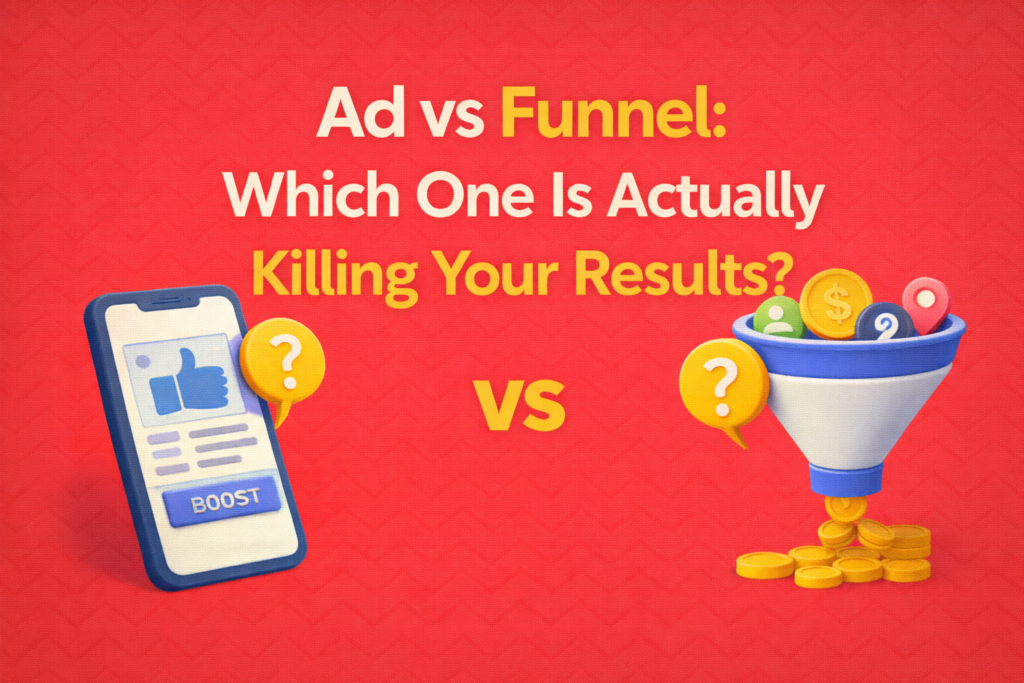
The truth is that poor results from a Facebook campaign can come from one of two places – the ad itself, or the funnel the ad is sending traffic into. These are two completely different problems with completely different solutions. Confusing one for the other is why so many businesses spend months testing creatives without ever seeing meaningful improvement.
This article is going to help you tell them apart.
Why This Distinction Matters More Than Most People Realise
Here’s a way to think about it. Your ad and your funnel have separate jobs.
The ad’s job is to find the right person in the feed, interrupt their scroll, make them curious or interested enough to click, and deliver them to your landing page. That’s it. The ad doesn’t close the sale. The ad doesn’t build trust over time. The ad doesn’t follow up with someone who showed interest but wasn’t ready to commit. All it does is get the right person to take one step: the click.
Everything that happens after the click is the funnel’s job. The landing page, the opt-in, the confirmation sequence, the email nurture, the retargeting campaigns, the booking process – all of that is the funnel. And the funnel’s job is to take the person the ad delivered and move them from curiosity to conversion.
When results are poor, only one of these two systems is the primary problem. But because people look at the final outcome – no sales, no leads, no booked calls – and not at where in the process the breakdown is happening, they default to blaming the most visible part: the ad.
The Metrics That Tell You Where the Problem Lives
You don’t have to guess which one is failing. The data tells you directly – if you know what to look for.
Open your Ads Manager and look at three numbers in sequence.
Click-through rate. This is the percentage of people who saw your ad and clicked it. A reasonable benchmark for cold traffic on Facebook and Instagram is somewhere between 1% and 3%, though this varies by industry and offer type. If your CTR is significantly below 1%, the ad is failing at its primary job – it’s not compelling enough to interrupt the scroll and generate a click. This is an ad problem.
landing page conversion rate. This is the percentage of people who clicked the ad and then completed the action on your landing page – whether that’s opting in, booking a call, or making a purchase. If your CTR is healthy but your landing page conversion rate is low, the ad is doing its job fine. People are interested enough to click. Something on the page is killing the momentum. This is a funnel problem.
Cost per result relative to your economics. If both your CTR and your landing page conversion rate look reasonable but you’re still not profitable, the problem is usually deeper in the funnel – the follow-up sequence isn’t converting leads into customers, or the offer economics don’t work at the cost per lead you’re achieving.
Run through these three metrics on your current campaign right now. The pattern will tell you which system needs attention.
Signs the Ad Is the Problem
Once you know how to look for them, ad problems have clear signatures.
Low click-through rate with high impressions. Your ad is being shown to people and they’re scrolling past without reacting. This almost always means one of three things: the hook isn’t strong enough to stop the scroll, the creative isn’t visually distinct enough to interrupt the feed, or the ad is speaking to the wrong audience entirely and the message isn’t resonating with the people seeing it.
High cost per click. Facebook charges more when your ad isn’t performing well because a low-performing ad is a worse user experience, so the platform penalises it with higher costs. If your cost per click is significantly higher than industry benchmarks for your niche, the ad quality score is low – which is usually a creative or relevance issue.
Low video view rate or short average watch time. If you’re running video ads and people are dropping off in the first three seconds, the hook isn’t working. The opening of your video isn’t giving people a reason to keep watching.
Good performance followed by sudden drop-off. If an ad worked well initially and then performance collapsed, this is usually audience fatigue – the same people have seen it too many times and are no longer responding. This is a targeting and creative refresh problem, which falls under the ad side of the equation.
In all of these cases, the fix lives in the ad: a stronger hook, better creative, more relevant copy, fresh audiences, or a combination of all four.
Signs the Funnel Is the Problem
Funnel problems are trickier to spot because they don’t show up in your ad metrics at all. Your Ads Manager can look perfectly healthy – good CTR, reasonable cost per click, strong reach – while your actual results are terrible. The problem is invisible inside the ad platform because it’s happening somewhere else.
Here are the signatures to look for.
Strong CTR but poor landing page conversion rate. People are clicking – which means the ad is working – but something on the page is stopping them from taking the next step. This could be a load speed problem, a message mismatch between the ad and the page, a confusing layout, an unclear call to action, or an offer that isn’t compelling enough when seen in full on the landing page.
A specific version of this problem worth watching for: the ad makes a promise that the landing page doesn’t immediately deliver. If your ad says “download the free guide to getting 50 leads per month” and the landing page headline says “welcome to our marketing hub,” that disconnect – even though it seems minor – registers instantly in the visitor’s brain as a red flag. They feel misled, even if you didn’t intend to mislead them. They leave.
Leads coming in but not converting downstream. This one is particularly frustrating because it feels like progress – you’re getting leads, the cost per lead looks acceptable – but nothing is turning into revenue. The leads go cold. They don’t book calls. They don’t buy.
This is almost always a follow-up problem. Either the email sequence isn’t strong enough to build trust and move people toward a decision, or there are no retargeting campaigns running to re-engage people who showed interest but didn’t act immediately, or the offer being made in the follow-up sequence isn’t positioned compellingly enough to convert someone who was initially on the fence.
High bounce rate on the landing page. If you have access to your website analytics; maybe via Google Analytics or Microsoft Clarity and you can see that people are landing on the page and leaving almost immediately within 10 to 15 seconds, the page isn’t delivering on what the ad implied. Either the load speed is too slow and they gave up waiting, or the first thing they saw when the page loaded wasn’t relevant or compelling enough to make them stay.
Good results on warm traffic but poor results on cold. If your retargeting campaigns or campaigns to warm audiences are converting well, but your cold traffic campaigns aren’t producing, the funnel is likely structured incorrectly for where cold traffic is in the buying journey. Cold audiences need more trust-building before they’re ready to commit. A funnel designed for warm traffic will underperform with cold traffic regardless of how good the ads are.
The Trap Most People Fall Into
Here’s where things get genuinely costly.
When results are poor and the instinct is to blame the ad, people start testing new creatives. They spend time and money producing new videos, writing new copy, designing new images. Each time they launch a new creative, the algorithm resets its learning phase and starts from scratch. Budget gets consumed during this learning period at a higher cost per result. And if the problem was never the creative in the first place, none of this testing produces the improvement they’re looking for.
So they test more. And more. And eventually they conclude that Facebook ads simply don’t work for their business – when what actually happened is they spent months solving the wrong problem.
The inverse happens too. People whose ads genuinely aren’t strong enough – wrong hook, wrong message, wrong creative format, instead focus on optimising the funnel. They rebuild their landing page. They rewrite their email sequence. They test different lead magnets. All of that effort produces minimal improvement because you can’t convert traffic that was never engaged by the ad in the first place. A funnel can only work with the leads the ad sends it. If the ad is sending low-quality, unengaged clicks, no funnel will convert them efficiently.
This is why diagnosing first matters so much. The time and money spent in the wrong direction doesn’t just fail to help – it actively delays the moment you discover and fix the real problem.
How to Diagnose Your Specific Situation
If you’re not sure which problem you’re dealing with, here’s the simplest diagnostic framework.
Start with your CTR. If it’s below 1% on cold traffic, start with the ad. Specifically, look at the first line of your copy and the first frame of your creative – these two elements determine whether someone stops scrolling, and they’re where most ad problems originate.
If your CTR is healthy but your cost per lead or cost per acquisition is too high, move to the landing page. Check load speed first – this is the most commonly overlooked issue and one of the easiest to fix. Then look at the clarity of your call to action and whether the offer on the page is as compelling as the promise in the ad.
If your landing page conversion rate is reasonable but you’re still not seeing revenue, the problem is in the follow-up. Map out exactly what happens to a lead after they opt in. How quickly does the first email land? What does it say? How many emails go out and over what time period? Is there a retargeting campaign following up with people who visited the page but didn’t convert? Are there ads specifically for people who downloaded your lead magnet but haven’t taken the next step?
Each of these is a separate diagnostic question, and each one points to a specific place in the system.
When It’s Both
The honest answer is that in a meaningful percentage of accounts, both the ad and the funnel have problems. The ad isn’t strong enough to attract high-quality clicks, and the funnel isn’t strong enough to convert the clicks it does get.
When this is the case, fix the funnel first. Here’s why: if you improve the ad first and start driving more traffic into a broken funnel, you’re just accelerating the loss. More traffic into a leaking system produces more wasted budget, not more results.
Fix the funnel until it can convert reasonably well on whatever traffic it’s currently receiving. Then improve the ad to drive more of that traffic – and at a lower cost – into a system that can actually handle it.
This sequence matters. Funnel first, ad second.
The Takeaway
When your Facebook campaign isn’t delivering, the question isn’t “what’s wrong with my ads?” The right question is “where in the system is the breakdown happening?”
The answer is almost always visible in the data. A low CTR points to the ad. A low landing page conversion rate points to the funnel. A low downstream conversion rate points to the follow-up. Each of these is a different problem in a different place, and each one has a different solution.
The business owners who get the best results from paid traffic are the ones who learn to read these signals clearly, and resist the urge to keep changing the most visible thing when the problem is hiding somewhere less obvious.