Does more traffic always mean more customers?
Traffic is up. Visitors are arriving every day. The numbers that used to make a business owner anxious are now moving in the right direction. So they wait for the sales to follow.
But the sale doesn’t happen.
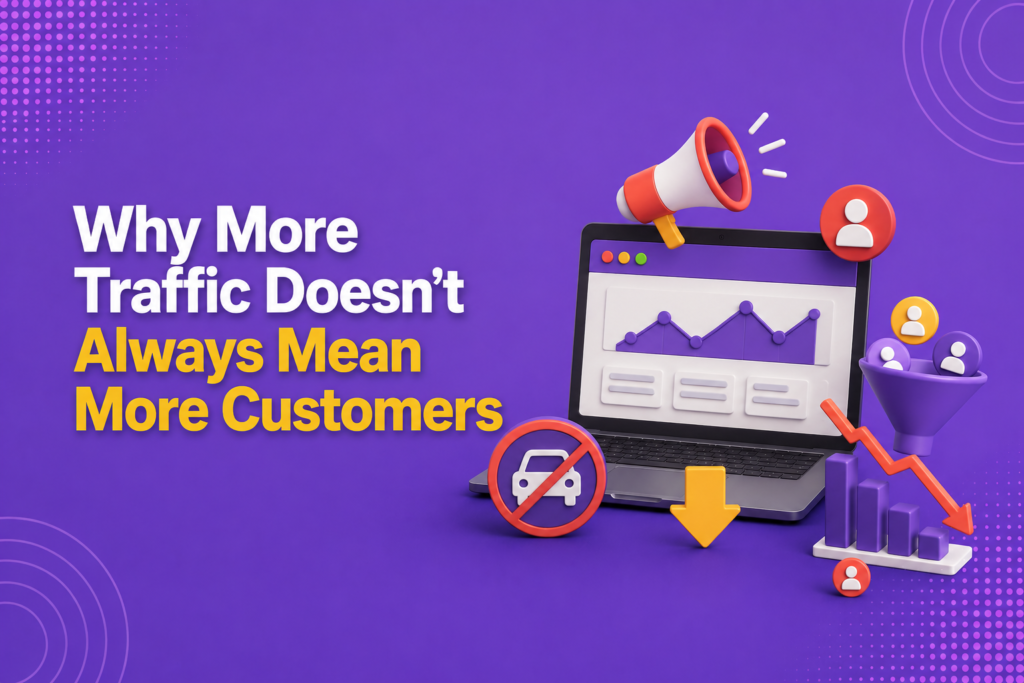
A week passes. Then a month. Traffic keeps climbing. Revenue stays flat. The disconnect is disorienting – because the logic seemed sound. More people seeing the business should mean more people buying from it right? That’s how it’s supposed to work – but something different is happening.
So the conclusion most people reach is the obvious one: we need even more traffic. If the current volume isn’t producing results, higher volume will. Run more ads. Post more content. Invest more in SEO. Double down on whatever is driving the numbers up.
What actually happens when they do this is rarely what they hoped for.
More traffic arrives. More people visit, browse, and leave. The conversion rate stays roughly the same – because traffic was never the problem. The problem was something the traffic was supposed to arrive to, and more traffic just means more people encountering the same broken experience.
This is one of the most expensive misdiagnoses in online business. And it’s so common precisely because the logic feels so reasonable. Traffic feels like progress. More traffic feels like more progress. The idea that traffic might be irrelevant to the actual problem – or worse, that more of it might be making things harder – doesn’t fit neatly into a dashboard.
But it’s true. And understanding why changes everything about how you approach customer acquisition.
Why Businesses Become Obsessed With Traffic
Traffic is visible. That’s the beginning and end of why it dominates the conversation.
You can open an analytics dashboard and watch it in real time. You can screenshot it, report on it, track it week over week, celebrate when it goes up, and diagnose when it goes down. It responds to actions in measurable ways – publish a piece of content and watch the spike, run an ad and see the numbers move. Traffic gives you the feeling of control that other parts of customer acquisition don’t.
Trust is invisible. You can’t watch it accumulate in a dashboard. There’s no metric that tells you how much credibility your brand has built with the audience it’s been reaching. It doesn’t move in ways that are immediately visible or attributable to a specific action.
Offer quality is subjective and uncomfortable to measure. It requires honest evaluation of whether what you’re selling is genuinely compelling to the people you’re selling it to – and that evaluation often produces answers that are difficult to act on quickly.
Conversion is visible in retrospect but hard to influence in the moment. You can see the conversion rate. You often can’t immediately identify why it is what it is or what specifically to change.
So businesses default to the variable they can see and influence most easily. Traffic becomes the proxy for progress because it’s the most legible part of a complex system. The problem is that legibility isn’t the same as importance. Traffic is easy to read. It’s not always the chapter that matters.
There’s also a social dimension to this. Traffic numbers are shareable. “We hit fifty thousand visitors this month” is a sentence that sounds like success. “We converted 0.3 percent of them” is a sentence that sounds like failure. The instinct is to keep talking about the number that sounds good and keep trying to grow it – which creates a culture inside businesses where traffic is treated as the goal rather than a means to one.
The goal was never traffic. The goal was customers. And the path from traffic to customers runs through variables that most traffic-obsessed businesses have never seriously examined.
The Customer Acquisition Equation
Here’s a framework that makes this concrete.
Customer acquisition isn’t a single-variable problem. It’s the product of four variables working together:
Traffic × Trust × Offer × Conversion = Customers
Traffic is the number of relevant people who encounter your business. Trust is the degree to which those people believe you can deliver what you promise. Offer is how compelling your proposition is to the right person at the right moment. Conversion is how effectively your process turns interested people into paying customers.
The critical word in that equation is product. Not sum. These variables multiply each other – which means that if any one of them is close to zero, the result is close to zero regardless of how strong the others are.
A business with enormous traffic, a compelling offer, and a clean conversion process but zero trust will generate almost no customers. Multiply anything by zero and you get zero.
A business with strong trust, a great offer, and excellent conversion mechanics but almost no traffic will also generate almost no customers – because there’s nobody in the system to convert.
A business with traffic and trust but a weak offer will generate interest that doesn’t convert – because even people who find you and believe in you won’t buy something that doesn’t feel compelling enough to act on.
This is why “just get more traffic” fails as a strategy for most businesses that are struggling. Traffic is one variable in a four-variable equation. Increasing it by ten times while leaving the others unchanged produces a proportional result – ten times more visitors going through the same experience and converting at the same rate. If that rate is near zero, the result is still near zero.
The businesses that grow efficiently are the ones that identify which variable in the equation is weakest and fix that first – because fixing the weakest variable produces the largest proportional improvement in the final result. And in most businesses that are struggling to convert traffic into customers, the weakest variable is not traffic.
When Traffic Is Not the Problem
This is the section worth sitting with. Because the scenarios below are more common than most business owners want to admit – and recognizing your own situation in one of them is the beginning of actually fixing it.
Scenario 1: People Visit But Don’t Trust the Business
The traffic is real. People are arriving, browsing, spending time on the page. And then leaving without buying, without enquiring, without taking any action at all.
What’s missing isn’t visibility. It’s credibility.
The visitor is applying the same skepticism they apply to every business they encounter online. They’re looking for signals that this business is legitimate, that it delivers what it promises, that other people have bought and been satisfied. And they’re not finding enough of those signals to feel safe taking the next step.
More traffic doesn’t solve this. It produces more people going through the same evaluation and reaching the same conclusion. The trust infrastructure needs to be built before more traffic will produce different results – the testimonials, the case studies, the demonstrated expertise, the consistency of presence that signals a real operation with real standards.
Scenario 2: People Visit But Don’t Understand the Offer
The business is getting traffic. But the messaging on the website or social media isn’t clear enough for a new visitor to immediately understand what the business does, who it’s for, and what changes if they buy.
Confused visitors don’t buy. They leave.
This isn’t a traffic problem – it’s a clarity problem. The offer might be genuinely strong, but if it’s buried in jargon, presented vaguely, or described in terms that only make sense to someone who already understands the business, it won’t convert.
More traffic means more confused people arriving, spending a few seconds trying to figure out what they’re looking at, and leaving. The fix is rewriting the messaging until a stranger can understand the offer in ten seconds. Then traffic becomes useful again.
Scenario 3: People Visit But Aren’t the Right Audience
This one is particularly common in businesses that have invested heavily in content marketing or SEO without tying their content strategy closely to their customer profile.
The content is attracting people. But the people it’s attracting aren’t potential customers. They’re curious browsers, students, competitors, or people with adjacent interests who will never buy what the business sells.
Traffic from the wrong audience is worse than no traffic at all – because it pollutes your analytics, makes your conversion rate look worse than it is for your real audience, and creates false confidence that the visibility strategy is working when it’s actually misdirected.
The fix isn’t more content or better SEO in the abstract. It’s a tighter content strategy aimed specifically at the people who have the problem the business solves and the means to pay for the solution. Smaller, more targeted traffic almost always outperforms larger, diffuse traffic when the goal is customer acquisition rather than vanity metrics.
Scenario 4: People Visit But Aren’t Ready to Buy
This scenario is the most misunderstood of the four, because it’s the one where everything is actually working – and the business still doesn’t get the immediate results it expects.
The traffic is right. The trust signals are solid. The offer is clear and compelling. But the visitor isn’t ready to buy today. They’re at an earlier stage of the decision-making process – researching, comparing, building familiarity before they commit.
These people are not lost. They’re in progress. But they will be lost if the business doesn’t have a mechanism to stay in contact with them until they’re ready. Without a lead capture system – an email list, a retargeting audience, some form of ongoing relationship – these visitors leave and never come back, not because they decided against the business but because there was nothing pulling them back when the timing became right.
More traffic in this scenario produces more people in the same situation – interested but not ready, with nowhere to go and no reason to return. The fix is lead generation infrastructure, not traffic volume.
More Traffic Often Makes Problems Worse
This is the part that sounds counterintuitive until you see the logic clearly.
A weak system under low traffic is an inconvenience. A weak system under high traffic is an accelerating failure.
Consider a website with unclear messaging and no trust signals. Under low traffic, it generates few visitors and few conversions. The cost of the problem is limited. Scale the traffic up with a paid campaign and what happens? More people arrive, encounter the same confusion and skepticism, and leave. The conversion rate doesn’t improve – it often gets slightly worse because the higher-traffic audience includes a broader range of people, many of whom are a poorer fit than the original low-traffic visitors.
Now the business is spending more money to generate more traffic that converts at the same near-zero rate. The cost of the problem has scaled. The problem hasn’t.
A weak offer under high traffic produces the same effect. More people see an offer that isn’t compelling enough to act on. More of them reject it. The business gets more data confirming that its offer isn’t working – which is useful information in principle, but not what they were hoping to learn when they invested in the traffic.
There’s also a subtler version of this problem. A business that’s been running ads to a weak conversion system for months has likely spent significant money with nothing to show for it. That budget could have been invested in fixing the trust problem, clarifying the offer, or building the lead capture mechanism that would have made every subsequent visitor more valuable. Instead it was spent amplifying a system that wasn’t ready to be amplified.
Traffic spend is only efficient when the system it feeds is working. Every pound or dollar spent on traffic before fixing the underlying conversion problems is a subsidy for a broken system. Fix the system first. Then scale the traffic.
The Real Problems That Prevent Customer Growth
If traffic isn’t the problem, what is? In practice, the answer almost always fits into one of six categories.
A visibility problem means the business isn’t reaching enough of the right people. Not a traffic volume problem in the generic sense – a targeting problem. The reach exists but it’s aimed at the wrong audience, or it exists in channels where the right audience doesn’t spend time.
A trust problem means the business isn’t building enough credibility with the people it does reach. The signals are weak, the proof is absent, the consistency isn’t there. People find the business, evaluate it, and decide not to risk it.
A lead generation problem means the business has no mechanism to capture interested people who aren’t ready to buy immediately. Every visitor who doesn’t convert on the first visit is lost permanently, because there’s no system to maintain the relationship until the timing is right.
An offer problem means what the business is selling isn’t compelling enough to the people seeing it. The outcome isn’t specific enough, the differentiation isn’t clear enough, or the risk of buying feels too high relative to the perceived value.
A conversion problem means the path from interest to purchase has enough friction that people who want to buy aren’t completing the process. The messaging breaks down at a critical point, the checkout is complicated, the next step isn’t obvious, or objections aren’t being addressed.
A systems problem means all the individual pieces exist but aren’t connected into a coherent customer journey. There’s content but no lead capture. There’s lead capture but no nurturing. There’s an offer but no clear path to it from the content. The visitor has no guided journey to follow – they’re left to navigate a disorganized experience and most of them don’t bother.
Each of these is a distinct problem with distinct solutions. None of them are solved by more traffic.
How to Diagnose the Real Problem
Before investing another pound in traffic, answer these questions honestly. They function as a quick audit of where your customer acquisition equation is actually breaking down.
Are the right people finding me?
Not just people – the right people. Check whether your existing traffic matches your customer profile. Are the visitors who arrive the kind of people who have the problem you solve and the means to pay for the solution? If your analytics show high traffic but your enquiries come from people who aren’t a fit, you have a targeting problem, not a volume problem.
Do people trust me when they arrive?
Put yourself in the position of a stranger encountering your website or social media for the first time. Is there specific, credible proof that you deliver what you promise? Are there real people with real results? Does the business look like it’s been operating consistently for a meaningful period? If you’re not sure, ask someone who doesn’t know your business to spend two minutes on your website and tell you what impression they formed.
Is my offer immediately clear and compelling?
Can a new visitor understand within ten seconds what you offer, who it’s for, and what changes if they buy? Can they articulate the outcome they’d be paying for? If your offer requires explanation or context to make sense, it’s doing too much work that your messaging should be doing instead.
Am I attracting the right audience at the awareness stage?
Look at where your traffic is coming from and what content or ads are driving it. Is that content specifically designed to attract people who have the problem you solve, or is it broad enough to attract anyone? Broad content builds audiences. Specific content builds customer pipelines.
Is there a clear next step for people who aren’t ready to buy?
What happens to the visitor who is interested but not ready to commit? Is there somewhere for them to go – an email list, a lead magnet, a lower-commitment offer – that keeps them in your world until the timing is right? If the only option is buy or leave, most people will leave.
Is the buying process frictionless?
Walk through your own conversion process as a customer would. How many steps does it take to buy? Where does it get confusing? Where do you have to ask the customer to do something that creates hesitation? Every unnecessary step is a place where a customer who was ready to buy could change their mind.
If the honest answers to these questions reveal problems, those problems are your priority – not traffic. Fix what’s broken in the system. Then increase the volume flowing through it.
Traffic Creates Opportunity. Systems Create Customers.
Traffic is not the enemy. It’s a necessary input. Without it, even the best-built customer acquisition system sits idle.
But traffic is an input, not an outcome. It creates opportunity – the chance to make an impression, demonstrate value, build trust, and earn a buying decision. Whether that opportunity is converted into a customer depends entirely on what the traffic arrives to.
A business with a weak trust foundation, an unclear offer, and no lead capture system will waste most of the opportunity that traffic creates. A business with strong trust signals, a compelling and specific offer, and a well-built conversion path will convert a meaningful percentage of the same traffic into customers.
The businesses that grow consistently online aren’t necessarily the ones with the most traffic. They’re the ones that convert attention into trust, trust into leads, and leads into customers – through systems that work reliably regardless of whether the founder is actively pushing them on any given day.
More traffic, applied to a working system, accelerates growth. More traffic, applied to a broken one, accelerates the cost of the problem.
Diagnose before you scale. Fix the equation before you multiply the inputs. Because in the Customer Acquisition Equation, traffic is only one variable – and it’s rarely the one that’s holding you back.