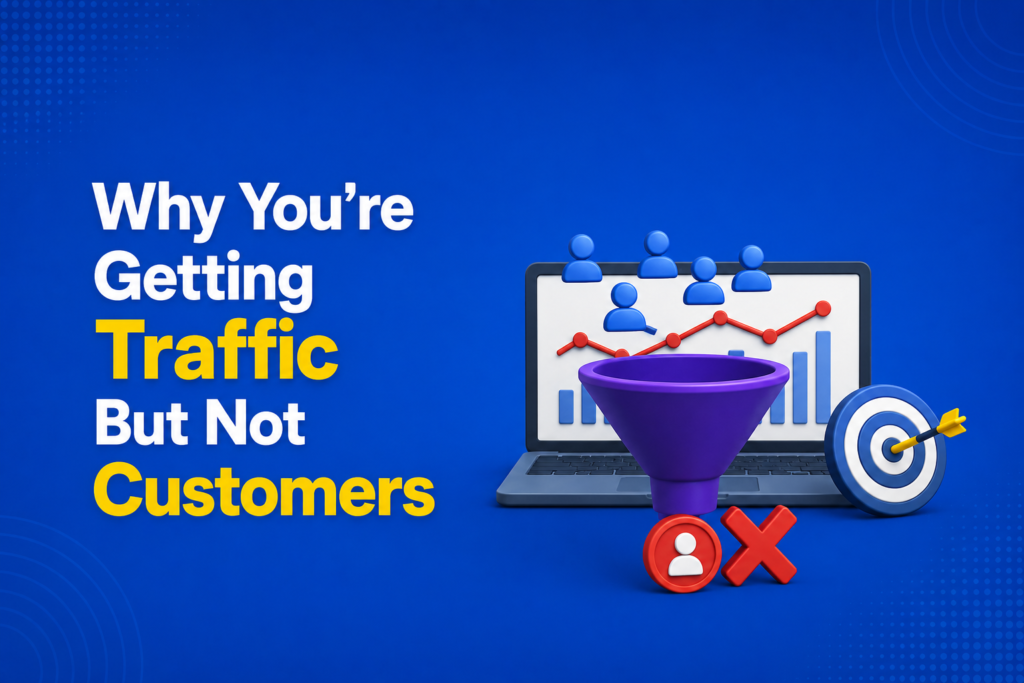
You’ve done the work. You’ve published content, maybe run some ads, optimized your pages enough to get people actually showing up. The traffic is real. The numbers are there. And yet your revenue doesn’t reflect any of it.
People are visiting your website and leaving without buying. Some of them are coming back – you can see it in the data – and they’re still not buying. You’re getting clicks, impressions, and good sessions. But the thing that actually matters, the thing that keeps a business alive, isn’t happening.
The temptation at this point is to conclude that you need more traffic. If the people who are visiting aren’t converting, bring more people in and rely on the numbers to eventually produce a result. It’s a logical response. It’s also almost always wrong.
Traffic and customers are not the same thing. They never were. A visitor is someone who showed up. A customer is someone who trusted you enough, understood your value clearly enough, and felt safe enough to give you money. Those are two completely different psychological states, and the distance between them is not covered by adding more visitors at the top.
The real question isn’t why you don’t have more traffic. It’s why the people already showing up are leaving without becoming customers. That question has a specific answer, and it almost never has anything to do with the volume of traffic coming in.
Most Businesses Are Measuring the Wrong Thing
There’s a reason traffic has become the default metric for online business success. It’s visible and measurable. It goes up and down in ways you can see in real time. When your traffic increases, it feels like progress – like the business is growing, like things are working.
But traffic is a vanity metric when it isn’t connected to a conversion strategy. Impressions are not customers. Clicks are not customers. Page views are not customers. Followers are not customers. Each of these things can exist in large quantities while a business generates almost no revenue, and many businesses are living proof of exactly that.
The confusion happens because traffic is the visible part of the process. You can watch it. You can screenshot it. You can report it. The deeper work – the work of building trust, communicating value, reducing friction, and earning a decision – is invisible. It happens in the customer’s mind, not in your analytics dashboard. So businesses optimize for what they can see and neglect what actually drives results.
Customer acquisition doesn’t begin at the moment of purchase. It begins the first time someone encounters your brand and starts forming an impression. Every interaction after that either builds toward a purchase or erodes the likelihood of one. Traffic is just the entry point. What happens after someone arrives – what they think, what they feel, what questions get answered and which ones don’t – is where customers are actually won or lost.
If your conversion rate is low, the problem is almost certainly somewhere in that post-arrival experience. More traffic just means more people going through the same broken process and leaving the same way.
Visitors Don’t Buy Because They Don’t Trust You Yet
Trust is the most underestimated variable in online customer acquisition. It’s also the one businesses are most reluctant to talk about because it’s slower to build than any other part of the funnel and harder to manufacture on demand.
When a stranger lands on your website, they bring with them a default level of skepticism. This isn’t personal – it’s rational. The internet has given people access to thousands of businesses making thousands of promises, and experience has taught them that a meaningful percentage of those promises don’t deliver. So they arrive cautious. They’re looking for reasons to trust you, but they’re equally alert to reasons not to.
Credibility
Credibility is the first thing they’re assessing. Does this business look legitimate? Does it communicate with the kind of specificity that suggests real experience? Are there real people behind it, with real credentials, real results, real history? Or does it feel assembled from a template – generic headline, stock photos, vague claims about transforming your business or helping you reach your goals?
The problem with generic credibility signals is that everyone uses them. Every business claims to be the best, the most experienced, the most results-driven. When every competitor says the same things, none of them are saying anything. Credibility comes from specificity – specific results, specific clients, specific methods, specific evidence. The more concrete the proof, the more convincing it is.
Social Proof
Social proof is one of the most powerful trust mechanisms available, but only when it’s used correctly. A wall of five-star reviews saying “great service, highly recommend” does almost nothing. A single detailed testimonial from someone who describes exactly where they were before they bought, what the experience of working with you was like, and specifically what changed afterward – that does a lot. The difference is that the generic review could apply to anyone. The specific one applies to your customer, and your customer sees themselves in it.
Authority
Authority matters too. Not authority in the sense of credentials and certificates, though those help – authority in the sense of demonstrating through your content and your communication that you understand the problem at a level that most people in your space don’t. When someone reads something you’ve written and thinks “this person really gets it,” they’ve just updated their trust level. That’s not an accident. It’s the result of content that goes deeper than surface-level takes and engages honestly with the real complexity of the problems your customers face.
Uncertainty
Underneath all of this is uncertainty – the quiet voice in every visitor’s head asking what happens if this doesn’t work. What if I pay and it’s not what I expected? What if I can’t get my money back? What if I’m making a mistake? Uncertainty doesn’t always get voiced. But it gets felt. And if your website, your messaging, and your offer structure don’t actively reduce that uncertainty – through guarantees, through clear expectations, through transparent communication about what the experience looks like – it quietly kills conversions that should have happened.
Visitors Don’t Understand What You’re Actually Offering
The second major reason visitors leave without buying is one that most business owners find uncomfortable to hear: your value isn’t as clear as you think it is.
You know exactly what you do and why it matters. You’ve been living in it. You can articulate your offer in your sleep, you understand the problem you solve at a deep level, and it seems almost impossible that someone would land on your website and not immediately understand what you’re about.
But you are not your customer. You have context they don’t have. You use language that’s intuitive to you and opaque to them. You lead with features and processes that make sense from the inside of the business and mean nothing to someone looking in from the outside.
Unclear Positioning
Unclear positioning is one of the most common silent conversion killers. If a visitor lands on your website and can’t answer “what does this business actually do and for whom?” within ten seconds, they leave. Not because they’re impatient – because they’re busy and there are other options. Confusion reads as a reason not to trust, and people don’t give confused businesses the benefit of the doubt.
Generic messaging
Generic messaging has the same effect. When your positioning could apply to any business in your category – “we help businesses grow,” “we provide expert solutions for your challenges,” “we’re passionate about helping you succeed” – you’ve said nothing. The visitor can’t tell whether you understand their specific situation or whether you’re just filling space with words that sound good. Neither inspires enough confidence to buy.
Feature-Focused Marketing
The deeper problem is feature-focused marketing – describing what you do rather than what it means for the customer. A feature is “we offer weekly strategy calls.” The value is “you never spend another week unsure of what to do next.” A feature is “our platform has 50 templates.” The value is “you can build a professional presence in an afternoon instead of paying an agency for weeks.” Features tell people what they’re getting. Value tells them why it matters to their life or their business. People don’t buy features. They buy the version of their situation that the features make possible.
Confused people don’t buy. Clarity is a prerequisite for commitment, and if your messaging creates any ambiguity about what you offer, who it’s for, and what changes as a result of buying, you are generating confusion where you should be generating confidence.
Your Offer Doesn’t Feel Compelling Enough to Act On
Sometimes the trust is there, the messaging is clear, the visitor understands exactly what you do – and they still don’t buy. When this happens, the problem is usually the offer itself.
An offer isn’t your product or service. An offer is the complete proposition: what you get, what it costs, what the experience looks like, what the outcome is, what the risk is, and what changes if you say yes today versus waiting. A weak offer is one where any of those elements fails to do its job.
Weak differentiation is one of the most common offer problems. If what you’re selling looks essentially identical to what five other businesses in your space are selling, at a similar price, the customer defaults to the cheapest or the most familiar. You haven’t given them a reason to choose you specifically. Differentiation doesn’t require doing something completely novel – it requires being clearer than your competitors about who you’re for, what makes your approach specific, and what outcome you can deliver that they can’t or won’t.
A weak or undefined outcome is equally damaging. “I’ll help you with your marketing” is not a compelling outcome. “I’ll build you a lead generation system that brings in qualified inquiries without you posting content every day” is. The difference is specificity. The first tells the customer they’ll get activity. The second tells them what changes. People pay for change – for a specific result in a specific area of their life or business. The more precisely you can describe that change, the more your offer feels worth acting on.
There’s also the question of risk. Every purchase above a trivial amount involves the customer taking on some level of risk – the risk that it won’t work, that the money will be wasted, that they’ll be worse off for having tried. A compelling offer acknowledges this and does something about it. A guarantee, a clear refund policy, a structured process that demonstrates you’ve thought about what happens if things don’t go as planned – these reduce the perceived risk of buying and make the decision easier to make.
The Buying Process Creates More Friction Than You Realize
Assume for a moment that a visitor trusts you, understands your value, and likes your offer. They’ve made the internal decision to buy. They click through to your checkout or contact page.
And then something goes wrong.
The form asks for more information than feels reasonable. The payment options don’t include the one they use. The page loads slowly. The next steps after submitting aren’t clear. The mobile experience is broken. Any one of these things can end a transaction that was otherwise complete.
Friction is anything that makes the process of buying harder than it needs to be. And businesses dramatically underestimate how much friction exists in their own buying experience, because they’ve never tried to buy from themselves as a stranger would.
Strategic friction shows up in consistent patterns: unclear next steps after showing interest, a contact page that asks for a call when the visitor isn’t ready for that level of commitment, a process that requires multiple back-and-forth exchanges before any value is delivered, a payment experience that feels disconnected from the trust the brand has built everywhere else.
Every unnecessary step between “I want this” and “I have this” is an opportunity for someone to change their mind. Not because they had a change of heart about the product – but because friction creates time, and time creates doubt, and doubt undoes decisions that were already made.
You’re Asking for Too Much, Too Soon
This might be the most widespread conversion mistake in online business.
A cold visitor – someone who has never encountered your brand before, who doesn’t know you, who hasn’t yet read your content or seen your results or built any familiarity with who you are – lands on your website. And your primary call to action is “Book a Free Strategy Call” or “Get Started for $1,997.”
The disconnect here is enormous. You’re asking someone to give you either their time in a live conversation or a significant amount of money, and they have known you for approximately four minutes. The level of commitment you’re requesting is completely mismatched with the level of trust they’ve had time to develop.
Trust is earned progressively. Before someone gives you an hour of their time on a call, they need to believe you’re worth an hour. Before they give you $2,000, they need to believe you’re worth $2,000. Those beliefs don’t form on first contact. They form through repeated, positive exposure over time.
The businesses that convert best don’t lead with their highest-commitment ask. They create a progression – a series of smaller steps that each require a little more from the visitor than the last, and each deliver a little more value in return. A free resource establishes that you understand the problem. A newsletter builds familiarity over weeks. A low-cost entry product lets someone experience the quality of your work with minimal risk. By the time you make the big ask, the customer has already said yes to you several times in smaller ways, and the trust required for the large commitment has been built organically.
Leading with your highest-commitment offer to a cold audience doesn’t save time. It costs you the customer entirely.
Many Visitors Leave Because There’s No System Pulling Them Back
Most visitors won’t buy on their first visit. This isn’t a failure – it’s just the reality of how buying decisions are made. People need time, multiple exposures, and reasons to return. The question is whether your business has any mechanism to make that happen.
A visitor leaves your website. Maybe they liked what they saw. Maybe they bookmarked it with every intention of coming back. Maybe they subscribed to nothing, gave you no contact information, and have no system pulling them back into your world. The algorithm moves on, life gets busy, and they simply never return – not because they decided against you, but because there was nothing keeping the connection alive.
Without a follow-up system, you’re relying on the customer to do all the work of remembering you. Most won’t, because you’re competing with everything else in their life for a fixed amount of attention. The businesses that convert visitors into customers consistently have mechanisms that do that work instead – email lists that keep the relationship warm, retargeting that re-exposes interested visitors to new content and offers, sequences that deliver value over time and build toward a natural purchase decision.
This isn’t about being aggressive or flooding people’s inboxes. It’s about recognizing that the first visit is rarely the final one, and building your system around the reality of how people actually buy. Repeated, valuable exposure is what transforms a curious visitor into a confident customer. Without a system to create that exposure, you’re starting the relationship over from scratch every time someone new shows up.
The Visitor-to-Customer Framework
Most conversion problems aren’t traffic problems. They’re trust problems, clarity problems, friction problems, or timing problems – and none of them get fixed by bringing more visitors into the same experience that already isn’t working.
Visitors become customers when 5 conditions are met:
- They understand the problem they’re facing and believe it’s worth solving.
- They trust the business they’re considering – its credibility, its proof, its authority in the space.
- They understand the value being offered clearly enough to know it’s right for their situation.
- The offer feels compelling relative to the cost and risk of buying.
- The process of actually buying is easy enough that it doesn’t create new hesitation after the decision has already been made.
When a visitor doesn’t convert, one or more of these conditions isn’t being met. The diagnostic work is figuring out which one – and that requires looking honestly at your website, your messaging, your offer, and your buying experience through the eyes of someone who doesn’t already know you and has no reason yet to trust you.
Traffic brings people to the door. Everything else determines whether they walk through it. Most businesses invest heavily in the first part and almost nothing in the second. The ones that flip that ratio are the ones that find themselves with a customer acquisition engine that compounds over time rather than a traffic strategy that costs more every year for diminishing returns.
The goal was never visitors. It was always customers.