You found a winning ad. The creative was working, the cost per lead good was good, and you were finally seeing consistent results. So you left it running.
Then somewhere between day 7 and day 14, something shifted. The cost per lead started climbing, and the campaign that was printing results a week ago is now barely moving. You didn’t change anything, but the performance is completely different.
This happens to almost every business running Facebook ads, and most people have no idea why. They assume Facebook changed something, or that the algorithm is being difficult, or that their ad just mysteriously stopped working. So they scrap the ad entirely and start over – which is usually the wrong move, and I’ll explain why in a moment.
What’s actually happening is predictable, and fixable once you understand the mechanics behind it.
The Real Reason Your Ad Died
Facebook’s ad delivery system doesn’t show your ad to your entire target audience all at once. It starts by showing it to the people within your audience who are most likely to respond – the low-hanging fruit. These are the people whose behaviour patterns most closely match what the algorithm predicts will engage with your ad.
In the first few days, you’re reaching the best-fit people in your audience. They respond well and you feel good about the campaign.
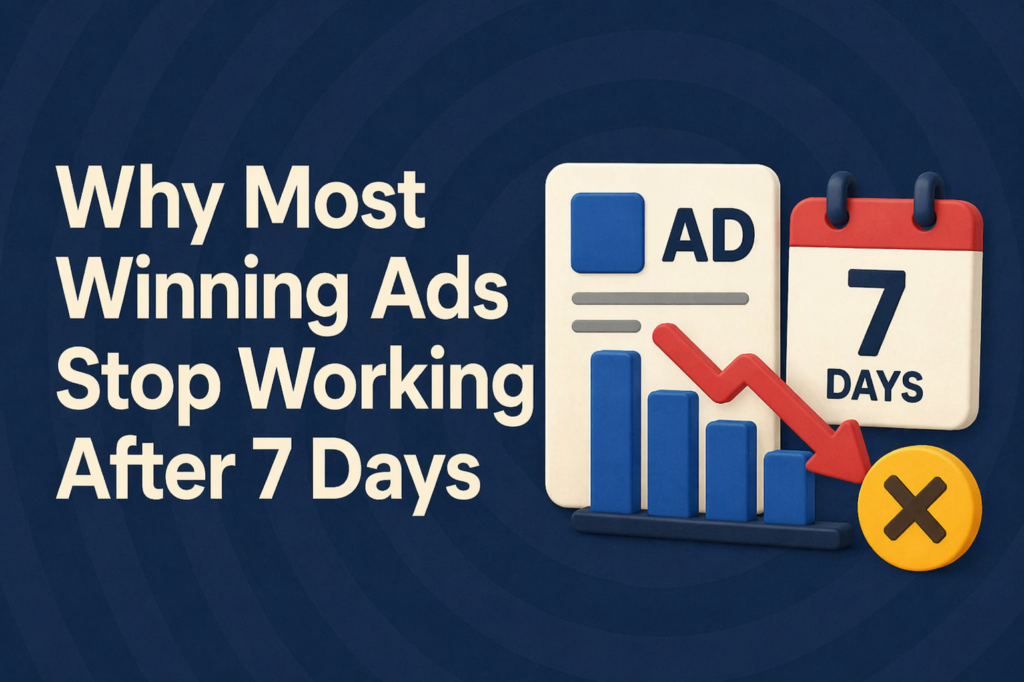
But that pool of highly responsive people is finite. As the campaign runs, you work through them. By day 7 or so, the algorithm has largely exhausted the most receptive segment and starts showing your ad to people who are a progressively weaker match. They respond less. Your CTR drops. Your cost per result climbs, and the campaign looks like it’s dying.
It’s not dying. It’s just run out of its most receptive audience within the current targeting parameters. This is called audience saturation, and it’s the single most common reason a winning ad stops winning.
The frequency metric is usually the clearest signal. When the average person in your audience has seen your ad three, four, five times without responding, they’ve made their decision. Showing it to them a sixth time doesn’t change that decision – it just costs you money and starts to feel intrusive.
Why Scrapping the Ad Is Usually the Wrong Move
Here’s the counterintuitive part. When performance drops, the instinct is to kill the ad and start fresh – new creative, new copy, new everything. And sometimes that’s the right call. But often it isn’t.
If your ad worked well in its first week, that’s real signal. The offer was compelling enough to get clicks. That intelligence has value. Throwing it away and starting from scratch means losing that signal and going back through the learning phase with a completely new ad, which costs time and budget before you see any results.
The better question to ask before scrapping anything is: did the ad fail, or did the audience run out?
These are different problems with different solutions. If the ad failed – low CTR from day one, poor engagement, high cost per click relative to your benchmarks – then yes, the creative needs work. But if the ad performed well initially and then declined, the audience is almost certainly the primary issue, not the creative.
What Actually Fixes It
There are three legitimate responses to audience saturation, and the right one depends on your specific situation.
Expand the audience. If your current audience is too small – which for most campaigns means under 500,000 people – the algorithm burns through the responsive segment quickly. Broadening the audience gives it more room to find new receptive people without showing the same ad to the same faces repeatedly. This might mean loosening your interest targeting, adding similar interests, or switching to a broader demographic with a tighter creative doing the filtering work.
Refresh the creative. If the audience is large enough but saturation is still happening, the solution is a new creative that reaches the same audience with a different approach. This isn’t scrapping what worked – it’s giving the algorithm new material to test against the same pool of people. Someone who scrolled past your original ad three times might stop for a different angle on the same offer. The offer doesn’t change, but the hook, the format, or the visual approach does.
Rotate creatives systematically. I don’t wait for performance to drop before introducing new creatives. I build rotation into the process from the start. Two or three creatives running simultaneously against the same audience means the algorithm can switch between them as each one fatigues, extending the effective life of the campaign without the cliff-edge drop that comes from running a single creative until it dies.
This last approach is the most sustainable long-term. It treats creative production as an ongoing operational requirement – not something you do once when you launch a campaign and then revisit only when things break.
The 7-Day Myth Worth Addressing
Not every ad fails at exactly 7 days. That number gets cited a lot in marketing circles and it’s roughly accurate as a general pattern, but the real variable is audience size relative to budget.
A small audience with a high daily budget saturates faster than a large audience with a modest budget. If you’re spending $100 a day against an audience of 80,000 people, you’ll burn through the responsive segment faster than someone spending $20 a day against the same audience. The math determines the timeline, not some fixed rule about seven days.
What’s consistent across accounts is the pattern: strong early performance, gradual decline starting somewhere between day 5 and day 14, plateau at a higher cost per result. Once you’ve seen it a few times, you recognise it immediately. And once you understand why it happens, you stop panicking and start responding correctly.
The Mistake That Makes This Worse
The most damaging response to early performance decline isn’t scrapping the ad. It’s making small, frequent adjustments trying to stabilise it.
Changing the budget, tweaking the audience, adjusting the bid strategy, pausing and restarting the campaign. Every one of these actions triggers a reset of the algorithm’s learning phase. So instead of letting the campaign find its footing through a temporary rough patch, you’re constantly pulling it back to square one.
I’ve seen ad accounts where the client was making changes every two or three days because they were anxious about performance. The campaign never had enough runway to stabilise because it was being constantly interrupted. The result was persistent mediocre performance and a growing conviction that Facebook ads just didn’t work for their business.
The discipline required here is to define your decision thresholds before you launch – at what cost per lead or cost per result will you intervene, and what specifically will you change when you do. Then hold to those thresholds rather than reacting to every daily fluctuation. Performance varies day to day for reasons that have nothing to do with your ad – day of week, competing advertisers, platform-wide trends. A single bad day is not a signal to change anything. A consistent pattern over five to seven days is.
What a Sustainable Ad Account Looks Like
The businesses that get consistent long-term results from Facebook ads are the ones who build systems around creative production and audience management that prevent the cliff-edge performance drops in the first place.
In practice this means: always have two or three creatives running simultaneously so the algorithm can rotate. Monitor frequency weekly and expand or refresh before saturation sets in rather than after. Treat creative production as a recurring cost of running ads, not a one-time setup expense. And when performance does drop, diagnose before you act – is this audience saturation, creative fatigue, a seasonal fluctuation, or something else entirely?
When you do it this way, you stop having the conversation about why your winning ad stopped working, because you’ve built a process that extends the life of winning creative, catches decline early, and responds with the right intervention rather than a panic-driven reset.
That’s not a complicated system. But it requires understanding why things happen, not just reacting to what the numbers show on any given day.