There’s a version of online marketing that assumes the customer journey looks like this: person sees your ad, person buys your product. Some businesses are built entirely on that assumption. They run ads, they post content, they make offers – and when people don’t buy immediately, they conclude that the ad was bad, or the content didn’t perform, or the offer needs a lower price.
What they’re actually dealing with is something much more fundamental. They don’t understand how buying decisions actually happen online.
Every customer, for almost every purchase above impulse-buy territory, goes through a predictable sequence of mental stages before money changes hands. Not every stage takes the same amount of time. Not every customer moves through them at the same pace. But the stages themselves are consistent – they show up whether you’re selling a $50 course or a $5,000 consulting package, whether your customer is a 24-year-old freelancer or a 55-year-old business owner.
The businesses that understand this sequence build marketing that works with human psychology instead of against it. The ones that don’t, they keep wondering why people “almost bought” or why their audience is engaged but never converts.
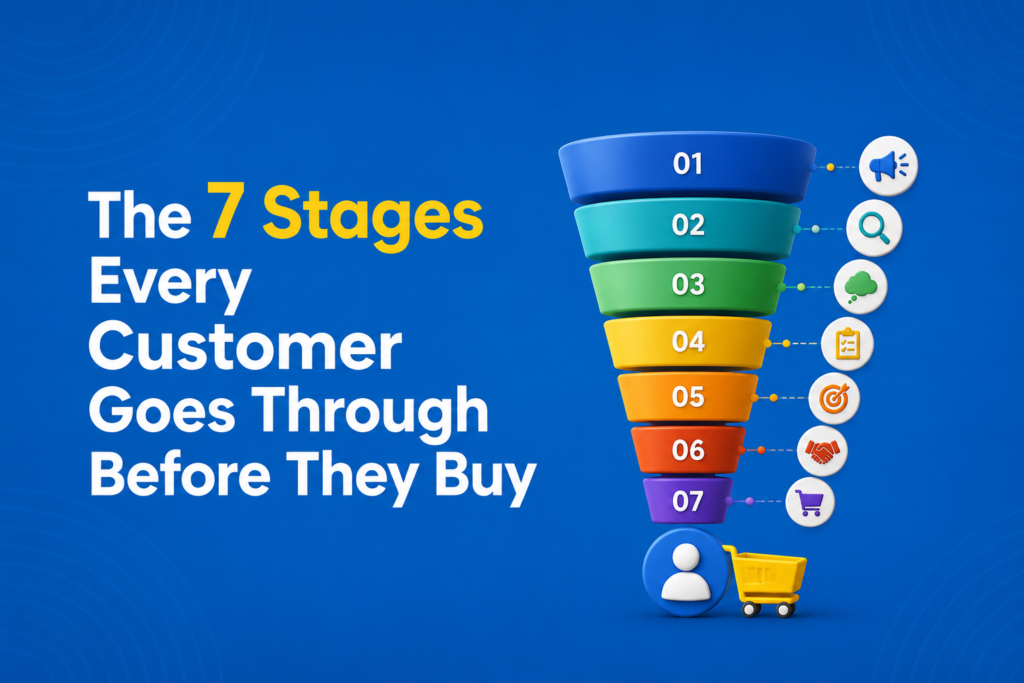
7 Stages Every Customer Goes Through Before Buying Online
Here are the seven stages, in order, and what’s actually happening in your customer’s head at each one.
Stage 1: Problem Awareness
Before anyone can buy a solution, they have to know they have a problem. That sounds obvious until you realize how many people are living with problems they haven’t consciously named yet.
A business owner might be losing customers consistently but hasn’t connected that loss to a specific gap in their follow-up process. They know something isn’t working. Revenue feels harder than it should be. They’re busy but not growing. But the problem hasn’t crystallized into something they can articulate – it’s more of a vague dissatisfaction than a defined challenge.
This is stage one. The customer is either completely unaware of the problem, or they’re a little aware that something is off but haven’t put a name to it yet.
Marketing that tries to sell at this stage almost always fails. You can’t pitch a solution to someone who doesn’t yet believe they have the problem you’re solving. If your first interaction with a cold audience is a direct offer, you’re speaking to maybe 3 percent of them – the small fraction who already know exactly what they need. The other 97 percent aren’t ready. Not because they’re the wrong audience, but because they haven’t reached the mental state where your offer makes sense to them.
The right move at this stage is awareness content – content that names the problem clearly, describes the symptoms in language the customer recognizes, and helps them think “yes, that’s exactly what’s happening to me.” You’re not selling anything yet. You’re giving people the vocabulary to understand their own situation.
This is also why good problem-awareness content gets shared so frequently. When someone reads a piece that perfectly describes a frustration they’ve been carrying around without being able to name, they forward it to five people who have the same frustration. You become the person who understood the problem before anyone else was even talking about it.
Stage 2: Solution Awareness
Once someone has acknowledged the problem, the next question is whether a solution even exists.
This stage often gets skipped in marketing conversations because it feels too basic. Of course people know solutions exist. But for many problems – especially newer, more nuanced ones – a large portion of your potential audience genuinely isn’t aware that the thing you offer is a viable path forward.
Someone might know their website isn’t converting but have no idea that conversion rate optimization is a service they can hire for. Someone might know their content isn’t reaching new audiences but not realize that a distribution strategy is a distinct problem with a distinct set of solutions. Someone might know they’re losing leads after initial contact but not know that a proper email nurture sequence could recover most of them.
At stage two, the customer is asking: “Is there actually a way to fix this, and what does that look like?” They’re not comparing options yet. They’re not evaluating vendors. They’re just figuring out what category of solution they should be looking for.
Content that works here is educational in the broadest sense – it explains that solutions exist, what the landscape looks like, and what different approaches involve. You’re helping someone understand the solution space before they’ve committed to any particular solution. Done well, this positions you as an authority who understands the terrain. Done poorly – or not done at all – you lose people at this stage to whoever explains the solution space most clearly, which might not be you.
Stage 3: Research
Now the customer knows they have a problem and knows solutions exist. They start looking.
This is the stage most marketers think about when they think about customer acquisition – and it’s important. But it’s the third stage, not the first. People who find you during research mode are further along the journey than people who are just becoming aware of the problem, but they’re also more intentional and more likely to be evaluating multiple options at the same time.
At this stage, the customer is consuming information aggressively. They’re reading articles, watching videos, listening to podcasts, asking questions in communities, looking at who the credible voices are in the space. They’re building a mental map of the solution landscape and starting to identify which approaches seem most credible or relevant to their specific situation.
What this means for your marketing is that discoverability matters enormously at stage three. If someone is actively researching the problem you solve and they can’t find you – through search, through social, through referral, through any channel – you don’t get a chance to earn their consideration. You’re not even in the conversation.
But showing up isn’t enough. The quality of what they find when they do encounter you shapes whether they keep you in mind or move on. A thin website with vague claims about what you do will lose to a competitor with a clear, detailed, credible body of content even if your actual work is better. First impressions at the research stage are often lasting ones.
Stage 4: Comparison
After research comes comparison. The customer has identified a shortlist – consciously or not – and is now evaluating options against each other.
This is the stage where differentiation becomes critical. If you look like everyone else in your category, the decision comes down to price. And competing on price is a race you don’t want to be in, because there will almost always be someone willing to go lower than you.
Comparison happens across several dimensions simultaneously. The customer is comparing outcomes – who seems most likely to actually solve my specific problem? They’re comparing evidence – who has the most convincing proof that they’ve done this before? They’re comparing experience – who feels easier or more pleasant to work with? And yes, they’re comparing price – but price usually becomes the tiebreaker, not the primary criterion, when everything else is close.
What’s worth understanding about this stage is that most of the comparison happens without you knowing about it. The customer isn’t necessarily calling you and your competitors side by side. They’re doing it privately, in their own time, using whatever information you’ve made publicly available. Your website, your testimonials, your content, your positioning – all of it is being silently evaluated against alternatives.
This is why businesses that think they don’t need to articulate what makes them different are leaving the comparison stage entirely to chance. If you haven’t made a clear case for why you specifically, the customer fills that gap with price or familiarity – neither of which you can fully control.
Stage 5: Trust Building
Someone can reach the comparison stage, decide you’re the best option, and still not buy. This is the stage that trips people up most – because logically, the decision should already be made. But buying requires a level of trust that intellectual comparison alone doesn’t always create.
Trust is the answer to a set of questions the customer is asking, sometimes consciously and sometimes not. Can this person actually deliver what they’re promising? Have they done this for someone like me? What happens if it doesn’t work? Are they going to disappear after I pay? Is this business real?
These questions don’t always get asked out loud. But they get answered through signals – the quality of your testimonials, the specificity of your case studies, whether your social proof involves people who look and sound like the customer, how you handle objections and uncertainty, how responsive you are in pre-sale interactions, the professionalism of your materials, and dozens of other small cues that people process without explicitly cataloguing them.
What makes trust-building complicated is that it takes time and it can’t be fully manufactured. A page full of generic five-star testimonials doesn’t build trust the way one detailed, specific case study from a customer in a recognizable situation does. Volume of praise is less convincing than specificity of proof.
This is also why businesses that rely entirely on paid advertising to cold audiences face structural challenges. They’re meeting people at stage one or two of the journey and trying to push them through to purchase without the trust infrastructure to support that transition. It can work, but it’s expensive – you’re paying to compensate for trust that could have been built organically over time through consistent, credible content.
The businesses with the lowest customer acquisition costs are almost always the ones with the strongest trust foundation. Their audiences convert faster and with less friction because the trust questions are already answered before the offer is even made.
Stage 6: The Decision
This is the stage most people think of as “conversion” – but the actual decision to buy is rarely a single moment. It’s more like the culmination of everything that came before, finally tipping past a threshold.
Something has to push the customer from “I think I’m going to do this” to “I’m doing this now.” That something is usually a combination of internal and external factors. Internal: they’ve hit a point where the cost of not solving the problem finally outweighs the discomfort of spending money or making a change. External: there’s a reason to act now rather than later – a deadline, a limited availability, a price change, a triggering event in their life or business.
The mistake most businesses make at this stage is assuming that a strong offer is enough to drive the decision. Sometimes it is. But often people need a specific prompt – a clear call to action, a deadline that’s real rather than manufactured, a direct invitation to take the next step. Without that, “I’m going to buy this soon” can stay in that state indefinitely. Not because the customer changed their mind, but because nothing ever gave them a reason to act today.
This is also the stage where objections live. The customer is on the edge of the decision and something is creating hesitation. Maybe the price feels like too much of a commitment right now. Maybe they’re not sure the timing is right. Maybe there’s a specific concern about whether this will work for their particular situation. If those objections aren’t addressed somewhere in your sales process – on your page, in your emails, in a conversation – they become silent deal-killers. The customer leaves without saying why, and you never get the chance to resolve the concern that was actually stopping them.
Handling objections isn’t about being pushy. It’s about anticipating the real questions people have at the edge of a decision and answering them honestly before they become reasons to walk away.
Stage 7: The Purchase
The decision has been made. Now the customer just needs to complete the transaction – and this stage has more failure points than most businesses realize.
The purchase stage is where the mechanics of your checkout process matter enormously. Every unnecessary step, every moment of confusion, every technical hiccup is an opportunity for someone who has already decided to buy to abandon the process. People are used to frictionless digital experiences. When the path to purchase requires effort – too many form fields, a confusing interface, a payment option they don’t trust or use, a page that loads slowly on mobile – some percentage of them will give up, tell themselves they’ll come back later, and never return.
There’s also an emotional component here that gets overlooked. The moment before completing a purchase, many customers experience a brief surge of doubt. Not about you specifically – it’s a natural human response to commitment. This is why the language and design of your checkout experience matters. Reassurance at this stage – a reminder of what they’re getting, a restatement of your guarantee, a note about what happens next – can be the difference between a completed purchase and an abandoned cart.
Getting someone to stage seven after taking them through stages one through six is a significant investment of time and effort, yours and theirs. It would be a waste to lose them here over a fixable mechanical problem.
What This Framework Actually Changes
Understanding these seven stages doesn’t just give you a model to think about. It changes how you build your marketing, what content you create, and how you measure whether things are working.
Most businesses market exclusively to people at stages five, six, and seven – people who are already aware, already comparing, already close to a decision. That audience is real and valuable, but it’s also the most competitive segment to be fighting over. Every business in your category is targeting the same late-stage buyers with the same direct-response tactics.
The businesses that win long-term are the ones that enter the conversation earlier. They create content that speaks to people at stage one, before the problem is even fully defined. They build educational resources for people at stage two who are trying to understand what solutions even exist. They show up consistently during stage three research so that when comparison time comes, they’re already familiar. By the time a customer reaches stages five and six, they’ve been encountering this brand for weeks or months – and the trust question is largely already answered.
This is the difference between businesses that feel like they’re always chasing customers and businesses that seem to attract them. It’s not luck or personality or some mysterious quality that some people have and others don’t. It’s a deliberate decision to meet people where they actually are in the journey rather than where it would be convenient for you if they were.
Your marketing isn’t just for people who are ready to buy right now. It’s for everyone at every stage of this process. When you build it that way, the results compound over time in a way that single-stage marketing never does.